


Forex trading is one of the most popular ways to participate in the financial markets.
For traders looking to start trading, the question often arises: ‘Is forex trading profitable?’
This article dives into the nuances of forex trading, explaining how it can potentially be profitable if approached correctly.
However, we also look at the stark reality that the majority of new forex traders lose money, and the reasons why this is.
We also offer suggestions for the best way to approach forex trading as a newbie, and how to increase your chances of successful forex trading.
What is forex trading?
Forex trading involves buying and selling currency pairs with the goal of making a profit from price fluctuations between the two currencies.
Currencies are traded in pairs, such as EUR/USD or USD/JPY, where the trader speculates whether one currency will strengthen or weaken relative to the other.
The forex market is now the largest financial market in the world, with a daily trading volume of over $7.5 trillion, according to the latest survey from the Bank for International Settlements.

FX trading supports global trade and investment by enabling currency exchanges between businesses, governments, and individual traders.
With the ability to access forex trading 24-hours a day, five days of the week, plus high liquidity and leverage options, the forex market is very attractive to new retail traders.
However, retail traders make up only a tiny percentage of the overall forex market – less than 5%.
But as of October 2024, it’s estimated there are over 10.5 million retail forex traders in the world, and this number continues to grow daily.
The remaining percentage are professional traders and brokers representing banks, financial institutions such as hedge funds, plus large corporations and governments.
Is forex trading really profitable?
Forex trading can potentially be profitable, but unfortunately the majority of new retail forex traders go about it the wrong way.
It’s akin to asking the question: ‘If I start a new business, will it be profitable?’
The answer, of course, depends on the way you go about starting a new business, and the skills, knowledge and discipline that you bring to the table.
The fact is, for over 83% of new traders, forex trading is not profitable.
While forex trading can be lucrative for some smart traders, the reality is sobering for others: the majority of retail traders lose money.
The reasons for this include:
- a lack of planning
- poorly-researched trading strategies
- inexperience and insufficient knowledge
- emotional decision-making.
Forex trading profitability depends heavily on the trader’s skills, knowledge, strategies, and discipline.
How MarketMates aims to help new traders
At MarketMates we aim to provide new traders with the skills and knowledge necessary to give traders a fair chance of trading successfully.
However, personal discipline and emotional control also play a large part in successful trading.
Therefore, we aim to assist all traders to take control of these psychological aspects of trading,too.
Statistics show that many retail traders struggle to turn consistent profits, or suffer severe losses, primarily due to poor risk management and a lack of education.
Cautious traders who follow a rules-based trading system, manage their risk carefully, and stay disciplined are able to achieve consistent returns over time.
We never forget the No. 1 Rule of Trading:
At MarketMates, we aim to teach traders how to use a low-risk rules-based trading system that has the potential to assist you to become a profitable trader.
Here my colleague and MarketMates CEO Sam Eder, author of the best-selling book ‘The Consistent Trader,’ shares with you a forex trading strategy that retuned 3% per month, with 75% winning months.
You’ll learn this in the FREE MarketMates’ course, The Advanced Forex Course for Smart Traders 2.0.
In this course we guide both new and more experienced traders through all the steps necessary to become a confident and consistent trader.
Reasons why forex trading can be profitable
- High liquidity: As the world’s most actively traded market, the fx market is highly liquid, allowing traders to enter and exit positions quickly at their desired price.
- Leverage: Forex brokers offer leverage, which allows traders to control larger positions with a smaller amount of initial trading capital, potentially increasing their returns (but also potential losses, too)
- Opportunities to go short or long in any market conditions: Forex allows for trading in both rising and falling markets. By going long (buying) or shorting a currency pair (selling), traders can exploit price movements regardless of direction.
- Low barriers to entry: Opening a forex account often requires minimal capital, making it accessible to a wide range of investors. Starting with a small trading account enables new traders to test strategies and gain experience without risking substantial funds.
- Round-the-clock trading: With forex markets open 24-hours a day, traders have flexibility in choosing trading sessions that suit their personal lifestyles and other commitments.
- Low transaction costs: Forex brokers typically offer low spreads, making it cost-effective for traders to execute frequent trades. MarketMates also assists traders to keep their costs down by offering subscription-based trading.
Reasons why trading may not be profitable
The reasons why many new traders aren’t profitable are many and varied.
Here you can read more about 43 things that Sam wishes he’d known when he first started trading over 20 years ago.
- High leverage risk: While leverage amplifies potential profits, it also increases losses, which can wipe out a trading account quickly if not managed carefully.
- Emotional trading: Many traders fail due to making emotional decisions, such as revenge trading or abandoning their strategies after losses.
- Lack of education: Without a solid understanding of market mechanics, price action, and risk management, traders are more likely to make costly mistakes.
- Overtrading: Frequent trades without a proper setup leads to higher transaction costs and reduced profitability. Many new traders overtrade, particularly if they don’t have a detailed Trading Plan specifying how many trades per week or month they should take.
- Incorrect use of stop-loss orders: One of the biggest issues we’ve identified that causes traders to lose money is incorrect use of stop-loss orders. Here you can find out more about adapting your exit strategy to changing market conditions.
- Market unpredictability: Unexpected geopolitical events or economic data releases can lead to rapid market movements, catching inexperienced traders off-guard and leading to large losses in a short space of time.
How profitable is forex trading?
The profitability of forex trading varies widely between traders.
Some traders earn modest but consistent returns by sticking to a well-tested trading plan, while others experience significant losses due to poor planning and risk management.
For example:
- Beginner traders: May break even or face losses as they develop their skills.
- Experienced traders: Can aim for monthly returns of 3–5% on their capital if they follow a disciplined rules-based trading system.
- Professional traders: Institutional traders often generate more consistent profits, but they trade with large capital and lower risk per trade.
Is forex trading high risk?
Forex trading is inherently high risk due to factors such as leverage, market volatility, and fast-moving price action.
While risk cannot be eliminated, it can be managed.
Effective risk management strategies that we encourage here at MarketMates include:
- Low capital risk: Limiting the percentage of capital risked per trade (e.g., 0.5%-1% per trade)
- Tight auto stop-losses: Setting tight stop-loss orders to protect against large losses
- Careful use of leverage: Avoid over-leveraging positions
- Calculated position-size: Base your position-size on R-multiples (risk-multiples)
- Stringent back-testing: Ensure you have adequately back-tested your trading strategy before placing trades
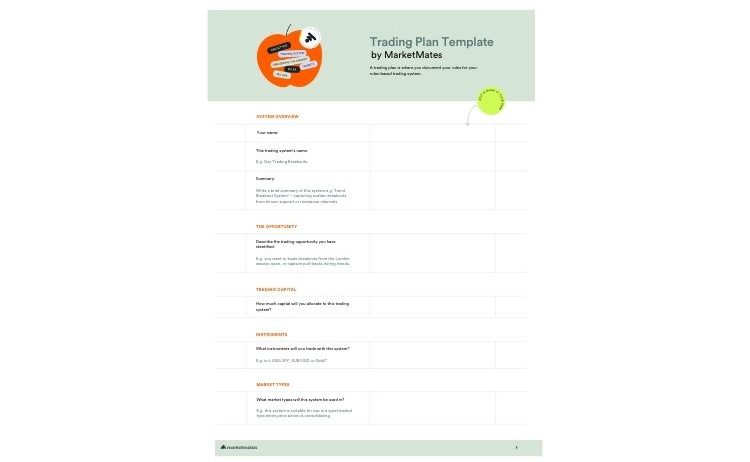
- Business planning: Running your trading like a business, with a comprehensive Trading Plan, a completed Traders’ Compass, and a Contingency Plan to guide your trading decisions.
Here are all of these MarketMates’ resources and templates to assist you as part of the FREE forex trading course we offer.
Is forex trading riskier than trading stocks?
All forms of trading carry their own risks.
Both forex and stock CFD trading come with their own particular risks, so it is not possible to generalise and say one type of trading is riskier than another.
For example, trading a highly-volatile minor currency pair which is known for its low liquidity and broad spread is far riskier than trading share CFDs of a stable major bank, which usually shows very little volatility.
In this case, the forex example is riskier than the share CDS example.
However, trading a highly-volatile share CFD such as Tesla (especially if Elon Musk is in a tweeting mood) could be considered far riskier than trading a major forex pair such as USD/SGD in a quiet period of trading with no trading session overlap.
Therefore, the risk undertaken by a trader can’t be generalised by asset class (such as forex pairs, CFDs, cryptos etc,) but rather depends on the particular financial asset which is selected to trade.
Ultimately, the risk level depends on the trader’s risk-management skills, knowledge and their general approach to trading.
It’s said that a highly-disciplined and organised trader can potentially trade almost any financial asset and not lose money.
Conversely, an inexperienced trader with poor risk-management and emotional control can (and probably will) lose money on all trading they attempt.
What are the most profitable forex trading strategies?
Here are some popular forex trading strategies known for their profitability when executed well:
- Trend trading: Traders follow the overall trend, using moving averages or trendlines to enter trades in the direction of the market
- Range trading: Profiting from price movements within defined support and resistance levels, often used in low-volatility sideways-moving markets
- Breakout trading: Entering positions when the price breaks through key levels, such as support, resistance, or consolidation patterns
- News trading: Taking advantage of market volatility following major economic announcements, like interest rate decisions or GDP reports

Final thoughts about forex trading profitability
Forex trading offers immense potential for profitability, but it’s not a guaranteed path to success.
The key to profitable forex trading lies in good education, solid risk-management, and having a well-thought-out trading plan to assist you to develop a consistent trading strategy.
While high liquidity, leverage, and round-the-clock trading present unique opportunities, they also bring significant risks to inexperienced traders.
It’s vital for trading success for traders to practice disciplined trading, and focus on achieving a favourable risk/reward ratio and low-risk position-size.
By combining knowledge with a rules-based trading approach, forex traders can give their trading an edge and increase their chances of consistent long-term success.
Till next time, I hope you remember to always trade safely.

If you like this article then sign-up for our newsletter or join over 42,000 traders and get The Advanced Forex Course for Smart Traders 2.0. It’s 100% free.
Sources
Marketmates uses only high-quality sources, including peer-reviewed studies, to support the facts within our articles. Read our editorial guidelines to learn more about how we fact-check and keep our content accurate, reliable, and trustworthy.
- Sam Eder – author of the trading book ‘The Consistent Trader’ https://www.amazon.com.au/Consistent-Trader-Winning-Trading-Psychology/dp/1631610252


