Fact checked

At MarketMates, we are committed to providing accurate information. Our content undergoes a rigorous process of fact-checking before it is published. Learn more about our editorial policy.
Last updated on January 13th, 2025
  Written by 
MarketMates Editorial Team
The MarketMates editorial team is led by ceo and co-founder Sam Eder, and consists of internal and external trading experts.
Our authors
  Reviewed by 
Sam Eder

Reviewer

Sam Eder
Sam is the cofounder and CEO of MarketMates. He has worked for brokers since 2008 and is the author of the Amazon best-seller 'The Consistent Trader.' His 'Advanced Forex Course for Smart Traders' has over 45,000 students.
Our authors

What is Liquidity in Forex Trading?

Find out all about liquidity in the forex trading market and how it affects spread

5 ChatGPT Prompts to Help You Pass Any Prop Firm Challenge

Build a rules-based plan in minutes using AI.

In this article

Secure Broker-backed Funding for Traders.

Try simple, flexible ‘balance-based’ challenges. 

MarketMates Logo

The MarketMates promise

At MarketMates, we are committed to providing accurate information. Our content undergoes a rigorous process of fact-checking before it is published. Learn more about our editorial policy.

In this article

When you start trading in the forex market, one of the fundamental concepts you’ll encounter is liquidity.  

This article explains what liquidity is, how it impacts forex trading, and how it varies across different currency pairs.  

We’ll also explore the concept of spread, and how it is influenced by changes in liquidity. 

What is liquidity? 

Liquidity in the forex market refers to the ability to buy or sell a currency pair without causing a significant change to its price.  

A highly liquid market is one where there are many buyers and sellers, making it easy to enter and exit trades quickly, and at a predictable price. 

The more buyers and sellers of a currency pair there are, the more likely it is that you will be able to enter and exit trades at the price you’re after, with tighter spread. 

What is spread?  

Spread is the difference between the bid price (the price at which you can sell a currency) and the ask price (the price at which you can buy a currency).  

It is the cost difference between buying and selling when making a trade, and is a key factor to consider when trading forex. 

The following diagram illustrates how to determine what the spread is on a forex trade, and how to calculate it.  

A diagram showing a forex price with illustrations of what is a pip and a spread
  • Tight spread: In a highly liquid market, spread is typically tight, meaning the difference between the bid and ask price is small. This is advantageous for traders, as it reduces the cost of trading. 
  • Widening spread: When liquidity dries up, such as during quiet market times, and around major economic events, spread tends to widen. This happens because there are fewer buyers and sellers, making it harder to match orders.  

Wider spreads increase the cost of trading, and can lead to greater slippage. 

What is slippage? 

Slippage in forex trading refers to the difference between the desired price of a trade, and the actual price at which the trade is executed.  

This slippage often occurs during periods of high volatility, or when the market is moving rapidly. 

Why does slippage occur? 

Slippage typically happens because the market conditions change between the time you place a trade order, and when that order is executed.  

Common reasons for slippage include: 

  • Market volatility: If the market is highly volatile, prices can change quickly, and by the time your order is filled, the price may have moved, and there may not be an equivalent buyer at the new price, so you may have to accept a less-desirable price in order to carry out your trade 
  • Low liquidity: In markets with low liquidity, there may not be enough buyers or sellers at the desired price, causing the trade to execute at the next available price in the queue 

There are two types of slippage 

  • Positive slippage: This occurs when the trade is executed at a better price than expected. For example, if you place a buy order at 1.1000 and it gets filled at 1.0995, you experience positive slippage 
  • Negative slippage: This occurs when the trade is executed at a worse price than expected. For example, if you place a buy order at 1.1000 but it gets filled at 1.1005, you experience negative slippage 

Why is liquidity and slippage important in forex trading? 

Liquidity plays a crucial role in forex trading for several reasons.  

The liquidity of a currency pair is directly related to the slippage you may experience when trading, so the two are inextricably linked.  

The reasons why liquidity is so important include:  

  • Smooth trade execution: High liquidity means you can execute your trades quickly at your desired price, reducing the risk of negative slippage 
  • Tighter spread: In liquid markets, the difference between the bid (buy) and ask (sell) price tends to be smaller. This reduces your trading costs and makes it easier to profit from small price movements 
  • Price stability: Markets with high liquidity are generally more stable, with prices less likely to fluctuate wildly 

How does the liquidity of major, minor, and exotic currency pairs differ? 

Liquidity varies depending on the type of the currency pair. 

Major currency pairs 

The six major currency pairs are:  

  • EUR/USD (Euro/US Dollar) 
  • USD/JPY (US Dollar/Japanese Yen) 
  • GBP/USD (British Pound/US Dollar) 
  • USD/CHF (US Dollar/Swiss Franc) 
  • USD/CAD (US Dollar/Canadian Dollar) 
  • AUD/USD (Australian Dollar/US Dollar) 

These pairs are the most liquid in the market due to the large volume of trade between the world’s major economies.  

For instance, the EUR/USD pair is the most traded pair globally, with consistently high liquidity and tight spreads. 

These pairs account for the majority of trading volume in the forex market. 

Minor currency pairs:  

These involve the major currencies but do not include the US dollar, such as: 

  • EUR/GBP (Euro/British Pound) 
  • EUR/AUD (Euro/Australian Dollar) 
  • GBP/JPY (British Pound/Japanese Yen) 
  • AUD/JPY (Australian Dollar/Japanese Yen) 
  • EUR/CAD (Euro/Canadian Dollar) 
  • EUR/CHF (Euro/Swiss Franc) 

Whilst still relatively liquid, these minor pairs are traded less frequently than major pairs, leading to slightly wider spreads. 

Exotic currency pairs 

Exotic pairs involve one major currency and one from a smaller or emerging market.  

These pairs are less liquid, meaning they have wider spreads and are more prone to price volatility. 

Examples include: 

  • USD/TRY (US Dollar/Turkish Lira) 
  • USD/ZAR (US Dollar/South African Rand) 
  • USD/MXN (US Dollar/Mexican Peso) 
  • USD/SGD (US Dollar/Singapore Dollar) 
  • USD/THB (US Dollar/Thai Baht) 
  • USD/HKD (US Dollar/Hong Kong Dollar) 

What is the volume of the most heavily traded currency pairs in the world? 

The global forex market reached $7.5 trillion daily in April 2022, according to the 2022 Triennial Central Bank Survey by the Bank for International Settlements (BIS). 

A line graph showing the increase in volume of forex trading from 1998 to the present year 2024

The most heavily traded currency pairs worldwide are the EUR/USD, USD/JPY, and GBP/USD.  

These pairs dominate the global forex market due to their liquidity and the economic influence of the countries involved. 

According to an April 2024 report from the Australian Foreign Exchange Committee (AFXC), the volume of the most-traded pairs was:  

EUR/USD (Euro/US Dollar):  

This is the most traded currency pair globally, with a trading volume that often exceeds $1 trillion per day.  

This pair is highly liquid due to the significant trade and investment flowing between the Eurozone and the United States. 

USD/JPY (US Dollar/Japanese Yen):  

This pair is the second most traded worldwide, and typically sees volumes of around $500 billion per day.  

The USD/JPY pair is heavily influenced by interest rate differentials and economic policies between the US and Japan. 

GBP/USD (British Pound/US Dollar):  

Known by its nickname as ‘Cable,’ this pair is also highly liquid, with daily trading volumes around $400 billion.  

It is popular due to the economic influence of both the UK and the US. 

These pairs are most active during the overlapping trading hours of the London and New York sessions, which contribute to their high liquidity and large trading volumes. 

Liquidity, volatility and spread: what’s the relationship? 

Volatility refers to the frequency and magnitude of price movements within the market.  

There is a close relationship between liquidity and volatility and spread: 

  • High liquidity = low volatility = tighter spread: In markets with high liquidity, prices are generally more stable, leading to lower volatility. This is because large orders can be absorbed without significantly affecting the price 
  • Low liquidity = high volatility = wider spread: When liquidity is low, even small trades can cause significant price movements, leading to higher volatility. This is often seen in exotic currency pairs or during times of market uncertainty. 
Diagram showing the relationship between liquidity, volatility and spread

What are the causes of volatility? 

  • Economic events: News releases, such as interest rate announcements or GDP reports, can often cause volatility, especially if the report or figures are unexpected or different from that predicted by market analysts 
  • Market sentiment: Shifts in trader sentiment, such as changes in risk appetite, can also lead to increased volatility 
  • Political instability: Political events or uncertainty directly affects currency values, leading to volatile price movements 
  • New events: Major world news events such as armed conflicts, natural disasters, extreme weather events or a pandemic outbreak can all contribute to volatility 

The chart below shows the effect on volatility in USD/JPY as the covid pandemic spread around the world in February and March 2020. 

A chart showing price action in early 2020 and what happened to the price of EURUSD when covid emerged

Factors affecting a currency pair’s liquidity 

Several factors can influence liquidity in the forex market: 

Time of day  

Liquidity will vary depending on the time of day.  

For example, the overlap between the London and New York trading sessions typically sees the highest liquidity in the 24-hour forex trading cycle. 

The diagram below shows the world time clock, and the overlap between currency sessions. The time when liquidity and trading volume are at their highest is in orange.  

Global trading hours for the forex market

Economic events  

Major economic announcements, such as interest rate decisions or employment reports, often affect liquidity by increasing market volatility and trader activity.  

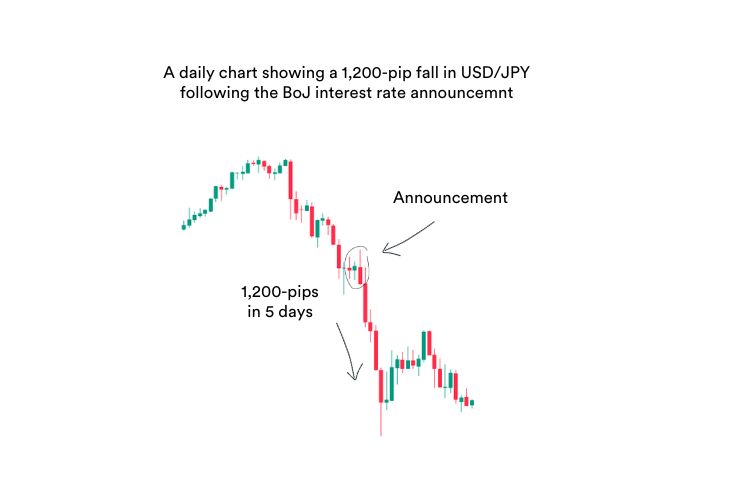
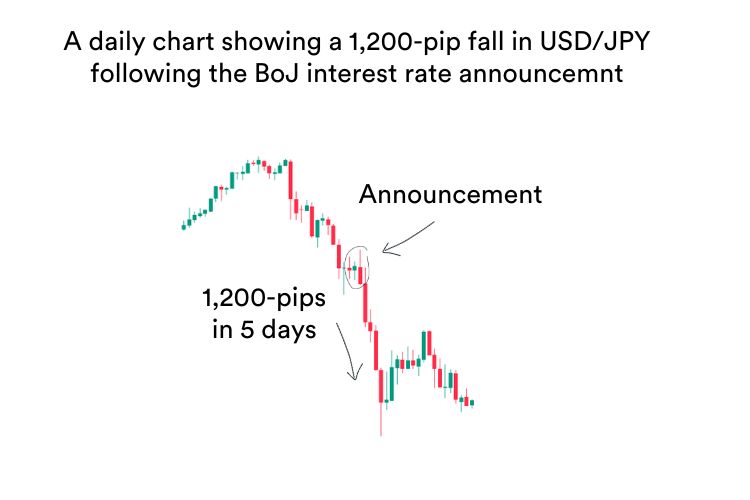
For example, at its July 2024 meeting, the Bank of Japan (BoJ) raised its key short-term interest rate from the prior range of 0 to 0.1% to 0.25%.  

It also announced plans to normalise monetary policy over time, part of the bank’s plan to lower its almost USD five- trillion balance sheet, and slowly retreat from the bond market. 

These announcements caused a sharp rise in the Japanese yen, with the US dollar plunging below 150. 

The unexpected rate hike caused significant volatility in currency, bond, and equity markets worldwide, and led to risk-off sentiment, with investors shifting towards safer assets like government bonds. 

The diagram below shows how the US dollar plunged compared to the Japanese yen following the Bank of Japan interest rate announcement: 

A trading chart showing the fall in the USDJPY after a Bank of Japan interest rate announcement

The type of currency pair 

Major currency pairs like EUR/USD or USD/JPY generally have higher liquidity compared to exotic pairs like USD/ZAR or AUD/SGD. 

This will always be the case, due to the difference in the volume of currency traded by major world players such as the Eurozone and the US, compared to emerging nations such as Brazil or Mexico.  

How to minimise slippage 

  • Avoid trading around major news events: The volatility surrounding major news announcements almost inevitably leads to slippage, so to avoid the risk many traders avoid trading around news events entirely  
  • Trade during liquid market hours: Trading during times of high liquidity, such as the overlap between the London and New York sessions, can reduce the chances of slippage 
  • Monitor market conditions: Being aware of upcoming news events or economic data releases can help you avoid trading during times of high volatility

Slippage is a common aspect of trading, but understanding it can help you manage your trades more effectively and mitigate potential losses. 

Final thoughts 

Liquidity is a vital concept to grasp in order to understand the forex market.  

It affects everything from how easily you can enter and exit trades, to the cost of trading through the spread you’ll be offered. 

By understanding the liquidity of different currency pairs, and how that affects volatility and spread, you’ll be able to make more informed trading decisions, and so better manage your risk. 

So, whether you’re trading major, minor, or exotic pairs, keep an eye on news events, and bear in mind that volatility and spread will be heavily affected by any news events that influence trader confidence.  

Till next time, happy trading!


Cate Signature

If you like this article then sign-up for our newsletter or join over 42,000 traders and get The Advanced Forex Course for Smart Traders 2.0. It’s 100% free.

Sources

Marketmates uses only high-quality sources, including peer-reviewed studies, to support the facts within our articles. Read our editorial guidelines to learn more about how we fact-check and keep our content accurate, reliable, and trustworthy.

  1. Triennial Central Bank Survey of the Bank for International Settlements (BIS) – https://www.bis.org/statistics/rpfx22.htm
  2. Bank of England Semi-annual Report on Foreign Exchange Turnover – April 2024  https://afxc.rba.gov.au/statistics/fx-turnover-reports/2024/apr-2024/index.html

Secure Broker-backed Funding for Traders.

Try simple, flexible ‘balance-based’ challenges. 

Picture of MarketMates Editorial Team

MarketMates Editorial Team

The MarketMates editorial team is led by ceo and co-founder Sam Eder, and consists of internal and external trading experts.
Picture of MarketMates Editorial Team

MarketMates Editorial Team

The MarketMates editorial team is led by ceo and co-founder Sam Eder, and consists of internal and external trading experts.

5 ChatGPT Prompts to Help You Pass Any Prop Firm Challenge

Build a rules-based plan in minutes using AI.

The Advanced Forex Course

for Smart Traders 2.0

Join over 42,000 traders and get FREE access to 17+ lessons and five hours of on-demand video based on the famous ‘Market Wizards’.

Keep Learning

Bank Desk Weekly
Sam Eder

Bank Desk FX Weekly 24 August 26

The US dollar remains under pressure, but this week could decide whether the weakness has further to run. PCE inflation and Fed Chair Kevin Warsh at Jackson Hole are the

Bank Desk Weekly
Sam Eder

Bank Desk FX Weekly 17 August 26

The US dollar starts the week under pressure as weaker jobs, inflation and retail data reduce expectations for another Fed rate increase.

Bank Desk Weekly
Sam Eder

Bank Desk FX Weekly 10 August 26

Weak US jobs have pushed the dollar lower and reduced expectations for further Fed rate hikes. Banks remain divided on what comes next, with US CPI, the RBA decision and

marketmates

Join over 42,000 Traders. 100% FREE.

The Advanced Forex Course
for Smart Traders