
Fact checked

At MarketMates, we are committed to providing accurate information. Our content undergoes a rigorous process of fact-checking before it is published. Learn more about our editorial policy.
Last updated on November 4th, 2025
  Written by 
MarketMates Editorial Team
The MarketMates editorial team is led by ceo and co-founder Sam Eder, and consists of internal and external trading experts.
Our authors
  Reviewed by 
Sam Eder

Reviewer

Sam Eder
Sam is the cofounder and CEO of MarketMates. He has worked for brokers since 2008 and is the author of the Amazon best-seller 'The Consistent Trader.' His 'Advanced Forex Course for Smart Traders' has over 45,000 students.
Our authors

What is a Trading Plan in Forex?

Find out what is a trading plan, what's included in a good trading plan, and get FREE examples and templates here from MarketMates

5 ChatGPT Prompts to Help You Pass Any Prop Firm Challenge

Build a rules-based plan in minutes using AI.

In this article

Secure Broker-backed Funding for Traders.

Try simple, flexible ‘balance-based’ challenges. 

MarketMates Logo

The MarketMates promise

At MarketMates, we are committed to providing accurate information. Our content undergoes a rigorous process of fact-checking before it is published. Learn more about our editorial policy.

In this article

If you’e wanting to find out what is a trading plan in forex you’ve come to the right place. 

A well-crafted forex trading plan is essential for all traders.    

The trading plan will act as your road map, guiding your decisions and actions in the volatile forex market.  

Without a clear plan, you risk making impulsive decisions that can lead to mistakes, and result in significant losses.  

A trading plan helps you stay disciplined, focused, and consistent, ensuring that you approach the market with a clear strategy rather than reacting emotionally to market movements. 

In this guide to ‘What is a trading plan in forex?’ we walk you through the basics of creating and implementing a good forex trading plan. 

This plan will outline your trading objectives, risk management strategies, and decision-making processes.  

We also include a link to a FREE MarketMates Trading Plan Template, plus other useful planning resources to assist your trading and help you take it to the next level.   

What is a trading plan and how to use it?

Yogi Berra quote if you don't know where you are going you'll end up someplace else


The famous American baseball catcher, Yogi Berra, said: 

“If you don’t know where you are going, you’ll end up someplace else.”  

The same applies to trading. If you don’t know what you want to achieve through trading, then how will you ever know if you’ve scored a home run?   

A trading plan clearly sets out what you hope to achieve by trading, and how you’re going to get there, step-by-step.  

Therefore, if you don’t have a trading plan, then you’ll undoubtedly get lost, or ‘end up someplace else,’ as Yogi put it. 

A trading plan is not a document to write then file away 

A good trading plan should cover several key components to provide a comprehensive guide for your trading activities. 

However, it is not a document that you should write and then file away to gather dust.  

It should be regarded as a continual ‘work in progress’ that is expanded upon and changed as you progress along your trading journey. 

You should keep it handy and refer to it often as you learn more about what works, and what doesn’t work for you, and the assets you are trading.

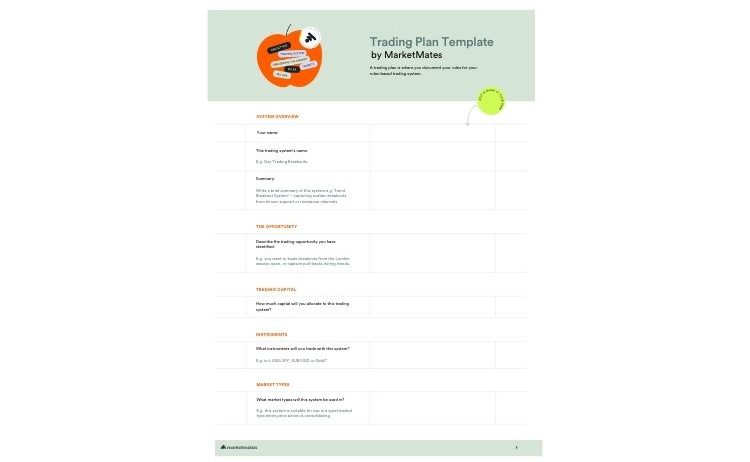
MarketMates Trading Plan template

Trading plan key components  

Your trading plan is your ultimate rulebook for every trading decision you make.  

Think of your trading plan as a blueprint or instruction manual for how you are going to become a consistent, successful trader.  

Ignoring your trading plan is a common trading mistake that beginners often make.  

The key components of a good trading plan include: 

  • Setting your goals and objectives for trading 
  • The trading strategy you will use  
  • How much money you’re going to allocate to your trading 
  • What you’re going to trade (the instruments, forex pairs or CFDs you’re going to concentrate on) 
  • What market type the strategy should be used in 
  • Your specific targets for the strategy 
  • What your position-sizing model is going to look like 
  • What a low-risk/high-reward trade looks like (your trade set-up rules) 
  • When to enter, exit and take your profits 
  • Your risk management rules, including where to place your stop-loss 
  • Guidelines for handling news events and exceptional events 
  • Any analysis or signals you will include in your plan
  • Scenarios for when to use discretion to ‘over-rule’ your fundamental trading rules 

How to use your trading plan  

Here is more detail about each of these key components of your trading plan, and how they can be used to assist you to become a more successful trader: 

Diagram with a target saying Objectives are targets to aim for

Setting your goals and objectives for trading 

Defining clear goals and objectives is the foundation of a successful trading plan.  

This involves setting specific, measurable, achievable, relevant, and time-bound (SMART) goals.  

A good trading plan should include: 

  • your expected return 
  • your maximum drawdown 
  • the number of trades you plan to execute 
  • your expected win rate 
  • your desired risk/reward ratio 

For example, you might aim for a 3% monthly return while limiting your drawdown to 2%. 

You may limit yourself to a set number of trades a day, or a week, and define the win rate you’re after. 

These goals help you stay focused, motivated, and aligned with your long-term vision, ensuring you remain disciplined and systematic in your approach. 

Here my colleague Sam Eder explains a lot more about setting your trading objectives in Lesson 4 of the MarketMates’ ‘Advanced Course for Smart Traders 2.0.‘ 

Diagram of Top five objectives

Defining the trading strategy you will use 

Your trading strategy outlines the rules and methods you’ll use to identify and execute trades.  

For example, you might use a strategy based on trading breakouts from periods of low volatility on a specific forex pair, for example USD/JPY.  

It should include the technical analysis tools you’re going to use, such as moving averages or Bollinger Bands, and what signals those trading indicators should give you, in order for you to trade the strategy. 

Your strategy should be back-tested and proven to work under various market conditions to ensure it is a robust, reliable and potentially profitable trading strategy.

Write down how much money you’re going to allocate to your trading 

Determining the amount of capital to allocate to your trading activities is crucial for risk management and sustainability.  

This involves setting aside a specific portion of your total investment capital exclusively for trading, ensuring it is an amount you can afford to lose without affecting your overall financial stability.  

For example, you might allocate $10,000 to your trading account, maintaining a buffer to absorb potential losses and avoid emotional decision-making under pressure. 

Understanding the power of leverage when using forex or CFDs to trade is vital when deciding how big a position to take.  

A diagram showing the relationship between margin, buying power and leverage on a see-saw

Decide what you’re going to trade

This involves writing down the instruments, forex pairs or CFDs you’re going to concentrate on.

Choosing the instruments you’ll trade is essential for focusing your efforts and developing expertise.  

Here you can find out more about trading forex vs stocks, and the pros and cons of both. 

This includes selecting the specific forex pair, stocks, commodities, or CFDs you intend to trade, based on your strategy and market knowledge.  

For instance, you might decide to trade major forex pairs like EUR/USD or GBP/USD due to their liquidity and volatility.  

Specialising in just a few instruments will allow you to better understand pricing behaviour, and improve your trading accuracy. 

If you are a beginner forex trader, start with just one currency pair, and get to know it really well before branching out. 

The type of market your trading strategy should be used in 

Identifying the type of market conditions your strategy performs best in is vital for its effectiveness.  

Markets can be trending, ranging, volatile, quiet or extreme, and your strategy should be tailored to one of these conditions.  

For example, a breakout strategy might work well in trending markets, but not in ranging ones.  

Understanding the market context helps you apply your strategy appropriately and avoid trading a strategy that is not suitable for the current market conditions. 

Diagram of a trading chart showing candlesticks in an extreme pattern

Your specific targets for that strategy 

Setting specific targets for your trading strategy helps measure its success and guide your trading decisions.  

These targets include your desired return on investment (ROI), maximum acceptable drawdown, and risk-reward ratio.  

For example, you might target a 1:3 risk-reward ratio, aiming to make $300 for every $100 risked.  

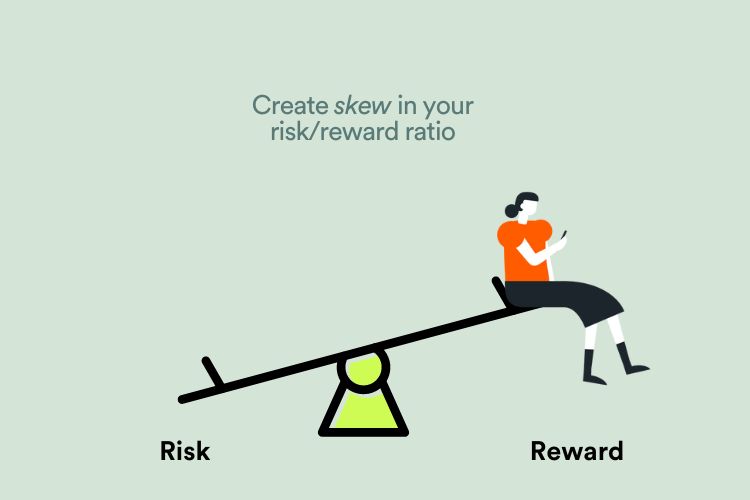
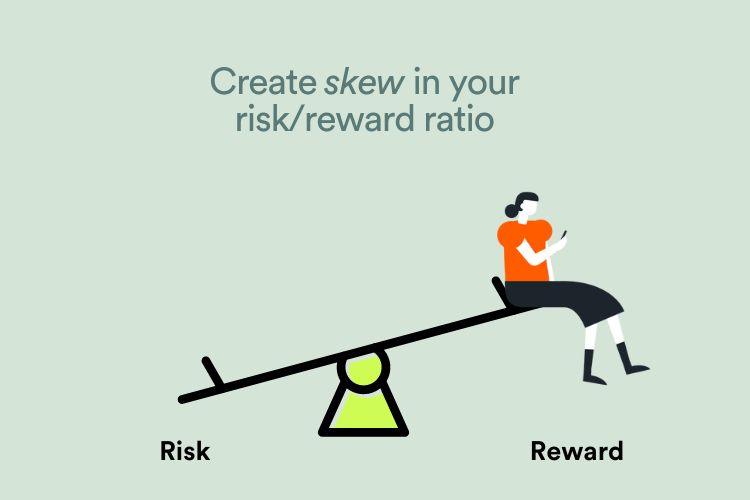
You should always aim for a risk/reward ratio that gives you an edge – so your losses are always smaller than your profit on a winning trade. 

This is known as creating ‘skew’ – so the odds are skewed or distorted in your favour.  

A diagram showing the balance between risk and reward with a female trader sitting on a see-saw

Having clear targets ensures you stay focused on your objectives and maintain a disciplined approach.  

What your position-sizing model is going to look like 

A position-sizing model determines how much capital you will risk on each trade, helping to manage your risk and optimise your returns.  

This involves calculating your position size based on your account size and risk tolerance. 

For example, you might risk between 0.5% and 2% of your trading capital on each trade.  

A 1% risk for a $10,000 account would involve risking $100 per trade. 

There are many different ways to calculate the most appropriate position size for your particular trading system.  

Proper position-sizing prevents significant losses and preserves your capital over the long term. 

Identifying what a low-risk/high-reward trade looks like 

Defining what constitutes a low-risk/high-reward trade is one of the keys to consistent results.   

This includes identifying specific trade setups that offer favourable risk-reward opportunities. 

For example, your setup may involve entering a trade when a currency pair breaks out of a consolidation pattern.

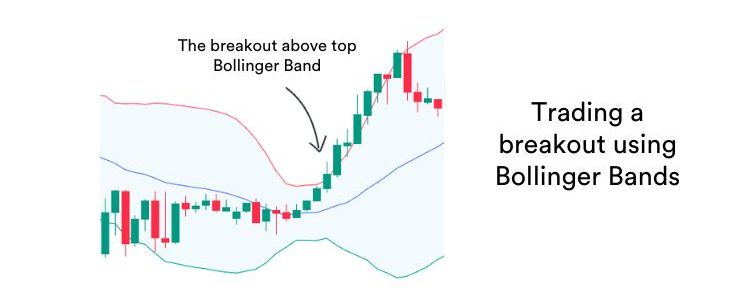
It may involve entering a trade when price action breaches above or below the top or bottom Bollinger Bands.  

A trading chart showing candlesticks in a breakout pattern with Bollinger Bands

By having clear setup rules, you ensure that you only take trades with a high probability of success and a positive risk-reward ratio. 

When to enter, exit and take your profits 

Having precise rules for entering, exiting, and taking profits ensures you execute trades systematically and avoid emotional decision-making.  

This includes defining your entry signals and exit strategies, like using trailing stop-loss orders and defined exit points.  

For instance, if you have entered a trade when the price breaks above the top Bollinger Band, you may exit in stages when your profit hits predefined profit targets, or at the top of an uptrend when the market shows signs of a reversal. 

Your risk management rules, including where to place your stop-loss 

Risk management rules serve to preserve and protect your trading capital, which should be every trader’s first priority. 

Risk management rules incorporate several aspects of your trading plan, which are all intertwined and linked. 

These include: 

  • defining your position size based on your objectives and risk profile 
  • setting automatic stop-loss orders to limit potential losses on each trade  
  • adhering to maximum drawdown limits 
  • adhering to your trading rules about how to manage losing streaks  

For example, your position size may state you only risk 1% of your trading capital on any one trade. 

You might place a stop-loss 1.5 times the Average True Range (ATR) away from your entry point, or decide to place your stop-loss so you only ever lose $100 on one trade. 

If you suffer a 10% drawdown on your trading capital, you may decide to make a rule that you will stop trading that week or month

These rules all combine together to form your risk-management strategy. 

Effective risk management ensures you survive losing streaks and maintain a sustainable trading approach. 

Guidelines for handling news and ‘exceptional events’ 

Having guidelines for handling news events and ‘exceptional events’ helps you navigate market volatility and avoid unnecessary risks.  

Exceptional events could include: 

  • the outbreak of a world-wide pandemic such as COVID 
  • the start of a war or armed hostilities between groups or nations 
  • a major natural disaster, such as the earthquake and tsunami which hit Indonesia in 2004, or the one which hit Japan in March 2011, sparking a potential nuclear disaster    

In your trading plan you’ll outline your actions and how you’ll behave when such events occur. 

For news events, your decision may include: 

  • Exiting trades before a major news announcement is due 
  • Deciding to remain in the trade (if your trading capital allows for a sufficiently large potential drawdown) and waiting for the bounce-back 
  • A decision to actively trade the news event with a planned strategy detailing when to enter and exit potential extreme event trades 

Alternatively, you might choose to avoid trading before or during major economic announcements, or geopolitical events that could cause unpredictable market movements.  

Being prepared for these events, and having a written plan to deal with them, helps you protect your trading capital and maintain stability in your trading. 

When to use discretion to ‘over-rule’ your trading rules 

While a rules-based approach is crucial, there may come times where using discretion is necessary.  

This involves having criteria for when to override your trading rules, such as during extreme market conditions or when unusual patterns emerge.  

For instance, you might choose to close a trade early if an unexpected geopolitical event significantly impacts the market.  

My advice to new traders is, if in doubt, get out. 

Using discretion to over-rule your trading rules may best be left to experienced traders. 

Implementing your forex trading plan 

Once you’ve developed your trading plan, it is crucial to implement it consistently.  

Here are some tips to help you stick to your plan: 

Develop discipline 

Strictly follow the rules of your trading plan, and avoid making impulsive decisions based on emotions.  

This does take discipline, and a certain amount of experience.  

You’ll find it easier to follow your trading plan if you know it really well, and explicitly trust in its outcome. 

To help you develop that discipline, do some backtesting and find out its expectancy number. 

The expectancy is a mathematical number based on a formula that tells you how likely your plan is to succeed.  

If your expectancy is over zero, then your system has a mathematical probability of being successful.  

This should give you confidence in your system, which in turn will make it easier to be disciplined and follow your trading rules to the letter.  

By monitoring and continually improving your trading system, you’ll develop the confidence required to trust your system, and the results it will inevitably provide. 

Manage strong emotions 

Learning to deal with strong emotions is one of the most important skills a new trader should aim to develop. 

Strong emotions, such as the fear of losing money, or elation when a large profit is achieved, will hinder your ability to make calm, rational decisions.   

Your trading plan will assist you to manage these emotions, providing clear rules for what action to take in each situation. 

However, this assumes that you do stick to your trading plan, which means controlling strong emotions that may lead you to ignore its rules, and make emotional decisions. 

Trading psychology is a huge subject, too big for the scope of this one page.  

However, it is a vital area to understand and master if you are to become a successful long-term trader. 

You can find out lots more on the subject of trading psychology here where my colleague Sam talks about the Master Trader’s Mindset (and how to think like a successful trader.) 

Review and adjust your trading plan 

Regularly review your trading plan and make changes and adjustments as needed, based on your trading outcomes and changing market conditions. 

As you progress in your journey as a trader, your trading rules may become more complex or nuanced. 

Or, as you test and trade your plan, you may come across areas that work well for you, and some that don’t.  

If this is the case, update your trading plan so that it remains a relevant, up-to-date handbook for how you are going to become a consistent, confident trader.  

Stay informed of market news 

Keep up-to-date with market news and developments that could impact your trades.  

It is important for all traders to have a clear macro-view of the market, and what makes it work.  

This will help you make informed decisions and adjust your trading strategy as necessary. 

More resources to get you started 

We have a range of useful MarketMates’ resources that you can access 100% FREE. 

These include: 

  • A comprehensive but simple-to-use Trading Plan Template 
  • A Trader’s Compass Template, which is another planning document aimed to help you take your trading to the next level 
  • A Contingency Plan Template, which will help you plan how to deal with unexpected events 
  • A Trade Recording Spreadsheet, which will help you keep a record of all your trades, and assist with the maths involved in monitoring and calculating your performance 
  • A series of unique indicators we’ve developed, that you can use if you use the TradingView charting software 

You can access all these useful free resources on our MarketMates Resources Pack. 

MarketMates Traders' Compass Template

Final thoughts 

Brainwave diagram MM style of person with hat

Crafting a successful trading plan in forex is a fundamental step for any beginner trader.  

By setting clear goals, managing your risk, and developing a solid trading strategy, you will have developed a good trading plan to assist you to become a successful trader. 

Remember, consistency and continuous improvement are the keys to long-term trading success. 

A good clear comprehensive trading plan will help you stay consistent and continuously improve your trading statistics. 

I’d encourage you to learn as much as you can about every aspect of trading before placing your first trade. 

Thank you for joining us. Till next time, happy trading!

Cate Signature

If you like this article then sign-up for our newsletter or join over 42,000 traders and get The Advanced Forex Course for Smart Traders 2.0. It’s 100% free.

Sources

Marketmates uses only high-quality sources, including peer-reviewed studies, to support the facts within our articles. Read our editorial guidelines to learn more about how we fact-check and keep our content accurate, reliable, and trustworthy.

  1. Investopedia – Trading Plan: Definition, How It Works, Rules, and Examples  https://www.investopedia.com/terms/t/trading-plan.asp
  2. Yogi Berra – Goodreads  https://www.goodreads.com/quotes/23616-if-you-don-t-know-where-you-are-going-you-ll-end

Secure Broker-backed Funding for Traders.

Try simple, flexible ‘balance-based’ challenges. 

Picture of MarketMates Editorial Team

MarketMates Editorial Team

The MarketMates editorial team is led by ceo and co-founder Sam Eder, and consists of internal and external trading experts.
Picture of MarketMates Editorial Team

MarketMates Editorial Team

The MarketMates editorial team is led by ceo and co-founder Sam Eder, and consists of internal and external trading experts.

5 ChatGPT Prompts to Help You Pass Any Prop Firm Challenge

Build a rules-based plan in minutes using AI.

The Advanced Forex Course

for Smart Traders 2.0

Join over 42,000 traders and get FREE access to 17+ lessons and five hours of on-demand video based on the famous ‘Market Wizards’.

Keep Learning

Bank Desk Weekly
Sam Eder

Bank Desk FX Weekly 24 August 26

The US dollar remains under pressure, but this week could decide whether the weakness has further to run. PCE inflation and Fed Chair Kevin Warsh at Jackson Hole are the

Bank Desk Weekly
Sam Eder

Bank Desk FX Weekly 17 August 26

The US dollar starts the week under pressure as weaker jobs, inflation and retail data reduce expectations for another Fed rate increase.

Bank Desk Weekly
Sam Eder

Bank Desk FX Weekly 10 August 26

Weak US jobs have pushed the dollar lower and reduced expectations for further Fed rate hikes. Banks remain divided on what comes next, with US CPI, the RBA decision and

marketmates

Join over 42,000 Traders. 100% FREE.

The Advanced Forex Course
for Smart Traders