


When asked his number one tip for traders, a hedge fund manager once told me:
“You need to start with your objectives.”
This is very true. Every rules-based trading system has clear and well-defined objectives.
Objectives are so important that Market Wizard Dr Van Tharp suggested up to 50% of system development time should be spent on your objectives.

In this lesson, you’ll learn the five main objectives you’ll need for your trading system.
Let’s get stuck in.
Your objectives are targets to aim for
You may be wondering how to set objectives without knowing what your trading system is capable of.
Think of objectives as the targets for your system’s performance.
You come up with objectives and then build a system to achieve them.
Initially, your system is unlikely to meet your objectives, but through the testing process, you will slowly change your rules until they do.
We’ll cover this in detail later in the course.
Objectives and position sizing
You achieve your returns based on your entry and exit rules and trade size (position-sizing model).
Trade size is arguably the most important part of the equation.
Think about it – if you take a tiny trade, even if you have a great entry, you won’t make much money at all.
Setting objectives will allow you to determine your position-sizing model – which is the subject of your next lesson.
After that, you will create the rules on when to enter and exit the market.

Setting your trading objectives
The main objectives you will need for your trading system are:
- Return: What percentage gains you are targeting over a month or year (such as 20% a year)
- Maximum drawdown: The percentage loss you are willing to risk on your account (such as 10% a year)
- Number of trades: How many trades do you expect to take over a period of time (such as 50 trades a year)
- Win rate: How many of your trades do you expect to be winners vs losers (such as a 50% win rate)
- Risk/reward ratio: The size of your losses compared to your winners (such as, winners will be three times the size of losses on average or 1:3)
Let’s go through these in detail now.
1. Return objective
The first objective is the percent return you are targeting the system to achieve.
You want to target a return over a time period such as:
‘This system objective is to return 3% a month.’
Every trader is going to have a different return objective. It’s a deeply personal choice based on risk tolerance and personal circumstances.
Here are a few considerations when working out your objective.
- The higher your targeted returns the greater risk you will need to accept. You will need to risk more of your account if you are trying to make 100% in a year compared to 10% a year.
- Do you have a goal you need to achieve? Some traders may have a goal given by a third party they are looking to achieve, such as a prop trading firm.
- How confident you are in your system? If you are experienced with your trading system, you can go for more aggressive targets. You need to be confident to trade at large sizes without making mistakes.
Consistent returns add up significantly over time, so don’t feel like you need to make 100% in a month or anything like that.
For example, if you make 20% a year and compound the gains, you will end up with over a 500% increase on your initial capital over 10 years.

Remember, as your return objective and the size of your trades are directly related to each other, setting a realistic objective will keep you safe while you test your system and gain confidence.
Having no objective can lead to over-trading, or trading too large for your account size.
Stanley Druckenmiller on returns
When thinking about returns, it’s valuable to discuss Market Wizard Stanley Druckenmiller‘s approach.
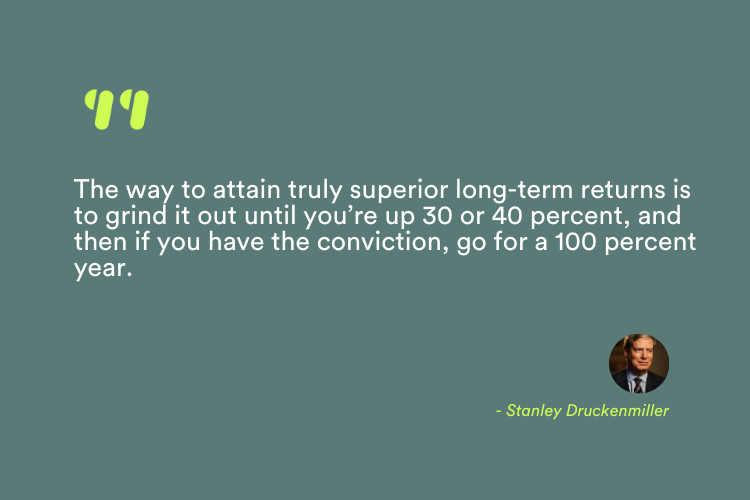
Druckenmiller targets 30% returns, with a chance of a 100% return.
He has achieved average returns of 30% over 30 years with this approach.
A few 100% returns a year over your trading career can make a huge difference.
Here is the impact of a single 100% year on the compounding returns I showed you above.

I was lucky enough to have a 100%+ return year, with tightly controlled risk, by taking a high-conviction trade and adding to it as the trade went in my direction.
But I could not go for a 100% return every year, and maintain the same risk tolerance.
Of course, if this happens once or twice in your career, it makes a significant difference to your long-term performance.
You can think about your returns this way. If you can earn a consistent return with the chance of a large return, that is much better than taking high-risk trades all the time.
2. Maximum drawdown objective
To make money, you need to risk money.
The good thing is that you are in control of what you risk.
The maximum drawdown is the amount of loss you are willing to sustain to go for your return objective.
Here is what this looks like on a chart:

For example, if your system has $10,000 capital allocated to it, and you lost $2,000, then you would be experiencing a 20% drawdown.
As a rule of thumb, your drawdown should be around half your return objective over a year.
If you are focusing on monthly returns, your drawdown might be the same as your monthly return objective.
You could have both monthly and annual return objectives. This is a good idea if you have a shorter-term trading system.
In this case, your monthly drawdown might equal your monthly return objective, while your annual drawdown is only half the annual goal.
For example:
As you can see from the table, if you have a 25% drawdown, you need to make a 33% return on your account to recover.
However, if you have a 50% drawdown, you will need a 100% return just to recover.
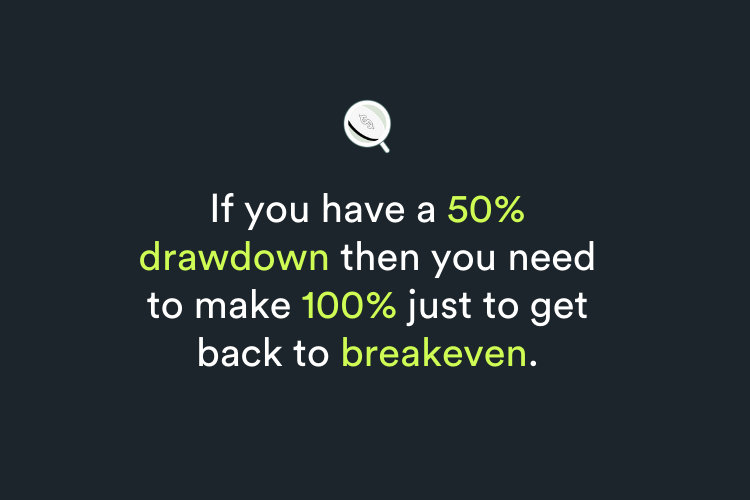
To give an example, let’s say you start with an initial investment of $10,000 in forex trading. After some trading, unfortunately, you experience a drawdown of 50%, meaning your account balance drops to $5,000.
Now, to get back to your original $10,000, you might think you only need a 50% return on your remaining $5,000, right?
However, due to the nature of compounding losses, this isn’t the case.
Here’s how it works:
Initial Investment: $10,000
Drawdown: 50%
Account balance after drawdown = $5,000
To recover, you need to not only make up for the $5,000 loss, but also reach your original $10,000 again.
Since you’ve lost 50% of your initial investment, you need to make $5,000 just to get back to $10,000.
This represents a 100% return on your remaining $5,000.
Losses also impact the amount of capital you have available for margin, so they can impair your ability to execute your trades.
Thus, I suggest you allow no more than a 25% drawdown or less.
The final point to make here is that it’s possible to have a drawdown limit much smaller than the return objective.
Market Wizard Dr Van Tharp went as far as to say that a day trader could have a 2% monthly drawdown limit, with a 25% return objective.
This is achieved through the position-sizing model, which is the topic of the next lesson.
3. Number of trades objective
How often you trade will significantly impact your position sizing and trading system performance.
Don’t ignore the importance of being very clear about how often you trade.
If you don’t maintain strict control over how many trades you are placing, you will likely trade too much.
Many traders tend to overtrade, and their returns suffer because of costs and mistakes.
The key is:
- planning how many trades you want to make
- building a position-sizing model around this
- being disciplined in only taking the number of trades you are supposed to take
For example, I looked for one trade a day (for my day-trading strategy). I was able to achieve my return target of 3% a month by doing this.
4. Win rate objective
You get to choose how many trades you get right versus how many you get wrong.
This may seem like an odd statement, and naturally, you can’t choose to get 100% of trades right (despite what you might see on YouTube).
So let’s explore how this works.
A major determinant of your win rate is how far your stop-loss is set, compared to your target for the trade.
This is a decision that is totally in your control.

For example, if you risk 10 pips with a target 20 pips away, you are more likely to hit your target than if your target was 100 pips away – hence you’d get a higher win rate.
But the lower the win rate, the harder your strategy will be to trade, as you will have to deal with taking lots of losses in a row.
Hopefully, you can see the relationship here.
This is because the higher your targeted win rate, the lower your profit per trade is going to be.
For example, if you want 80% of your trades to be winners, you will generally need to take your profits quickly.
Conversely, if you have a targeted win rate of only 20%, by definition, you will need to let your profits run and go for fewer, but bigger wins.
I find it a good idea to think about your win rate in combination with your risk/reward ratio objective below.
5. Risk/reward ratio objective
Your risk/reward ratio is the relationship between the size of your losses compared to your winners.
Here is how you calculate your average risk/reward ratio:

If you have a risk/reward ratio of 1:1, then your losses and winners are of equal size.
If your risk/reward ratio is 1:2, your winners are two times the size of your losers.
Win rate and risk/reward ratios are closely connected.
For example:
Let’s assume you have a win rate of 50% and a 1:3 risk/reward ratio.
In this case, if you win half the time, and make three times your risk when you win, you can expect a healthy return.
Let’s look at this scenario over 10 trades assuming you either lose $100 or make $300.
You can see that with a 50% win rate, you can still come out on top if you have a superior risk/reward ratio.

What is the right risk/reward ratio for your system?
Here’s what Market Wizard Paul Tudor Jones has to say on the topic:
“I’m looking for 1:5. One to five means I’m risking one dollar to make five. What one to five does is allow you to have a hit ratio of 20%. I can actually be a complete imbecile. I can be wrong 80% of the time, and I’m still not going to lose.”
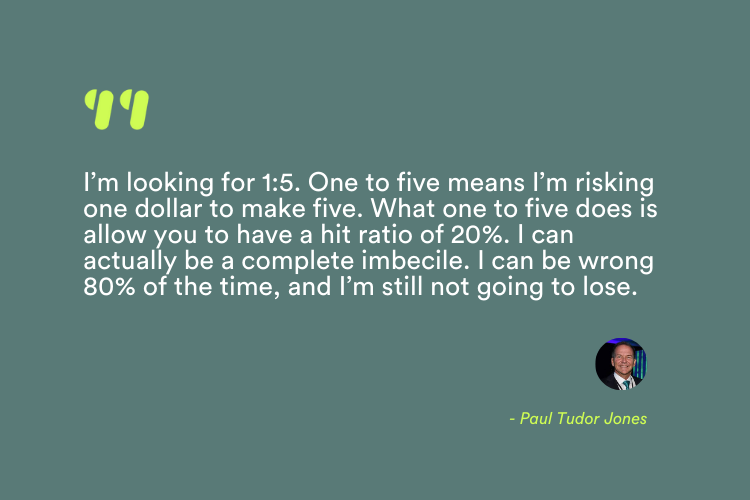
This is one of the most important lessons from the Market Wizards, and perhaps the main reason I have been consistently profitable.
If you have the discipline to trade with a risk/reward of 1:5, it will take you most of the way towards having a winning trading system.
When I trade, I always target four times my risk.
This does not mean I don’t take profit unless I get four times my risk (although I have done that and it worked.)
Rather, it means I want to have an average risk/reward of 1:4 over a series of trades.
We’ll cover how to do this in future lessons.
In saying that, setting your system’s risk/reward profile remains a balance between consistency (win rate) and profitability (risk/reward).
Crafting your objectives
Now you know how to craft objectives for your trading system.
Remember, these objectives will guide your position sizing, entry and exit rules, and ultimately your trading success.
Don’t rush this step – take the time to carefully consider each objective and how it aligns with your overall trading goals.
In the next lesson, we’ll delve into position-sizing – the key ingredient to determining how much you make or lose in the market.
Lesson #5 Achieving Your Goals Through Position Sizing
Till next time,


