


Are you just starting out on your trading journey and looking for trading lessons for beginners?
The financial markets offer endless opportunities for profit, but navigating them requires knowledge, skill, and discipline.
To help beginner traders, we’ve compiled this list of 10 of the most important trading lessons for beginners to assist you on your journey.
These trading lessons are a summary of more than 30-years of forex and CFD trading which Sam Eder and I have between us.
Once you’ve absorbed these vital lessons, check out our other trading course for beginners plus find advanced forex trading tutorials.
Top 10 online trading lessons for beginners
1. Preserve your trading capital
The No. 1 rule for all traders is preserve your trading capital.
This rule sits above all others, because if you run out of trading capital, it’s game over.
You can preserve your trading capital by using risk management techniques, such as only ever using 2% of your trading capital on any one trade.
Having a trading plan that uses sound money management techniques will also help to ensure your trading journey is a long and satisfying one.
2. Never trade with money you can’t afford to lose
Never trade with money that you can’t afford to lose.
By this, we mean don’t trade using funds in your everyday account that you need to pay your rent or mortgage, buy food with or pay your utility bills.
If a trade goes the wrong way, it should never result in you facing dire financial hardship.
The money you use to trade should be kept in a separate trading account, completely distanced from your everyday living funds.

3. Always stick to your trading plan
Your trading plan is a roadmap to guide you in your trading journey. All beginner traders should have one before they start trading.
It should tell you exactly how to choose a trade, how to set it up, and how to execute your trade.
A good trading plan will also set out the money management and risk reduction strategies that you are going to use.
Here’s our free MarketMates Trading Plan Template plus other useful resources.
Never ignore your trading plan or go against the rules you have established for your trading.
4. Keep it simple, and only trade one asset at a time
As a beginner it’s easy to get carried away as you learn to trade forex, and make things too complicated.
Stick to one form of trading, and keep your trading system simple at first.
There’s always time to add more entry rules or discover advanced trading techniques later on.
At first, keep it simple and stick to trading one market at a time with a clear entry and exit strategy.

5. Carefully plan every trade you make
Experienced and successful traders carefully plan each trade they make.
When placing trades, they have a clear understanding of why they are making that trade.
You should know what your entry and exit points are, and how much you stand to gain or lose, depending on which way the trade goes.
Every trade you make should be planned in advance with a good risk/reward profile in mind.
You should ALWAYS have a stop loss order in place to get out of the trade if it is unsuccessful.

6. Start small and build up slowly
It’s a great idea to start small when beginning to trade CFDs, and gradually build up your knowledge and confidence.
If you are only risking a small loss on each trade you make at first, you’ll feel less pressure.
Take your time practicing opening and closing trades until you feel comfortable with the process of trading.
Gradually build up the size of your trades as you gain experience.
7. Accept that losses are part of trading
Many trades you place will not go in the direction you plan.
Experienced traders understand this, and treat losing trades as a ‘cost of doing business’.
Accept that trading losses are inevitable. Being comfortable losing money is an essential part of a successful trader’s mindset.
Try not to see losses as a ‘failure,’ but rather as part of a series of trades, some of which will be winners, and some losers.

8. Have realistic expectations
Trading is not a ‘get rich quick’ game, and it takes time to learn to become an experienced and successful trader.
It’s important to maintain realistic expectations when you first start to trade.
Success in trading takes time, effort, and a commitment to learn and improve.
However, by having realistic expectations about your trading, you can avoid disappointment and gradually build up your skills and experience as a trader.

9. Don’t be afraid to step away if something doesn’t feel right
If you have allocated a set time of the day or week to trade, there can be an expectation to get on and trade, even if something doesn’t quite feel right.
Never feel pressured to place a trade if something’s not quite right.
Maybe the rules of your trading plan haven’t been met, or the setup isn’t quite right? Or perhaps you have a headache or don’t feel well?
If something doesn’t feel right, don’t be afraid to step away from your trading desk and make no trades that session.
The financial markets are not going anywhere, and they will always be there for you tomorrow.

10. Keep a trading diary or journal to document your progress
Keeping a trading journal or diary is an excellent way to record your progress as a trader, or to remind yourself about things that didn’t go to plan.
This is an important part of your learning journey, and will help you continuously improve your knowledge and skills as a trader.
Regularly looking back over your trading diary can be a fun way to remind yourself of the progress you have made from a beginner trader, to a more confident and experienced trader.
It can also help you avoid repeating common trading mistakes.

How to improve your trading skills as a beginner trader?
The best way to improve your trading skills as a beginner trader is to apply these lessons every time you trade.
- Take time to plan your trades carefully, and check that your position-size is within your acceptable and affordable risk limits
- If you are not confident, take a step back, decrease your trade size, and build into your trade slowly
- When you trade, it’s important to be comfortable with the fact that not every trade is going to be a winner
- Learn from your losses, and don’t beat yourself up. If you do this, then over time you will have fewer losses and bigger winners. That’s why recording and reviewing every trade you make is essential
Remember that learning to trade is a marathon, not a sprint.
The most frequent mistakes that beginner traders make
Now that we’ve looked at the most important trading lessons for beginners, it’s time to look at the most common mistakes that novice traders make.
I’ve taught a lot of people how to trade since I first began trading in 2008. In my experience, the most common mistakes that beginner traders make are:
- They don’t thoroughly plan their trades carefully enough (which is why we here at MarketMates encourage a ‘rules-based trading‘ approach)
- They don’t automatically set up a stop-loss order for each trade they place, and let their losses build up
- They don’t have an ordered set of rules for when to exit a trade, so they tend to get out too quickly, and potentially cut their profits short
- They don’t understand the relationship between position-size and risk. They often open positions that are too large for the size of their trading account
- They use too much leverage on their trades, and so take too much risk on just one trade
- They don’t back-test their trading system sufficiently (or even worse, start trading without a trading system at all)
- They don’t record their trades accurately enough to allow for reflection and learning from past mistakes
- They don’t plan for emergencies, and so get caught unawares when a major unplanned event does take place
- They trade in adverse conditions, or when feeling unwell or stressed, and so end up making poor trading decisions
- They don’t step back and reflect after a series of losses, to give themselves time to emotionally calm down and centre themselves again
Final thoughts
I believe that by following these lessons for beginner traders, and avoiding the most common mistakes, you’ll be setting off in the correct direction at the beginning of your trading journey.
Also, it’s worth recording and remembering the most frequent mistakes beginner traders make, so you don’t end up repeating the same mistakes.
It is by learning from our past mistakes that we grow, both as people and as traders.
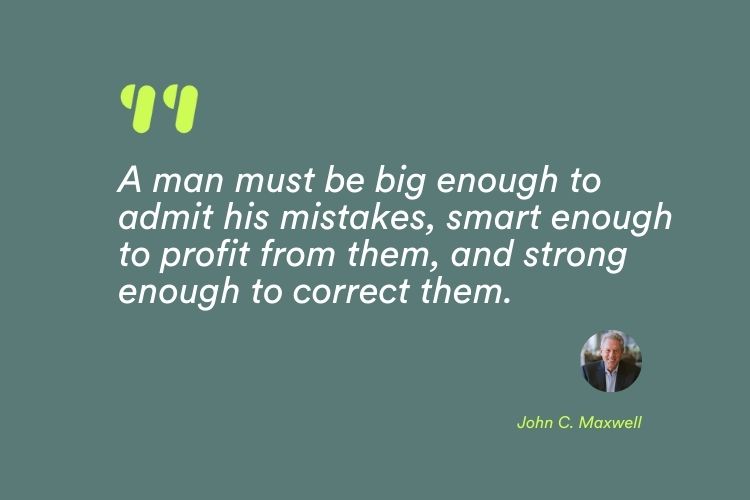
I always remember the wisdom shared by John C. Maxwell in his book The Difference Maker when he said:
“A man must be big enough to admit his mistakes, smart enough to profit from them, and strong enough to correct them.”
Till next time, happy trading!


