


A forex trading strategy is a plan which details the methods and rules you’ll follow to enter and exit trades.
Having a well-planned trading strategy is absolutely crucial for success, and no trader should start work without one.
Whether you’re a beginner or a more experienced trader, understanding and implementing the right strategy for the trading conditions you face can make a significant difference to your trading outcome.
In this article we look at nine essential forex trading strategies that every beginner trader should know about and understand.
We also explain how to develop trading strategies that work for you, whether you trade forex, gold, shares, or any form of CFDs.
What are forex trading strategies?
A forex trading strategy is a comprehensive plan designed to assist your trading decisions.
It is like a road map to guide you on your trading journey, detailing exactly how you’ll carry out your trading.
Trading strategies are built around predefined rules and criteria, which combine together to help you make sensible and consistent trading decisions when buying and selling currencies.
Effective forex trading strategies take into account various factors, including the current market conditions, your risk tolerance, and your trading objectives.

Key elements of forex trading strategies
A trading strategy is all about how, when and why you enter and exit trades. It details the chart patterns, trends or price behaviours to look for in order to execute trades.
The plan details the style of trading you’ll undertake, and how you’ll use your strategy to enter and exit trades.
It describes the set-up you’ll look for before opening a trade, and the indicators or conditions that must be present before you take a position.
Your written strategy will ensure your trading decisions are based on objective analysis, rather than emotions or a whim.
By adhering to a well-defined strategy, you can maintain consistency and discipline in your trading activities.
Components of a trading strategy
Forex trading strategies vary in complexity.
In its simplest form, your initial strategy may just be one or two sentences describing what, when and how you’re going to trade.
For example, a simple strategy may say:
‘I’m going to be a trend trader, and trade price breakouts above or below the top or bottom Bollinger Bands.’
This simple statement does contain the key elements of a trading strategy a beginner may use – it explains:
- how you’re going to trade (trend trade)
- what the entry requirements are to open a trade (price breakout)
- what tools or indicators you’re going to use to generate a trade signal (price reaching above or below the top or bottom Bollinger Bands)
The diagram below shows this simple trading strategy mapped out on a forex trading chart.
We see price action in a consolidation phase, then a sudden price breakout above the top Bollinger band.


A strategy lacking detail
However, this simple trading strategy is lacking some detail. For example:
- When exactly is the trade to be entered – on which candlestick? At the open of the chosen candlestick, or on the close?
- When is the trade to be closed?
- How much profit should be targeted?
- Where will the stop-loss be set?
A more comprehensive trading strategy will answer many more of these questions, leading to a much longer, more detailed document.
For example, these additional details may include:
- what chart patterns should precede the breakout?
- the Bollinger Band indicator settings to be used
- any other price behaviours or conditions that must be present before a trade is entered into
Your trading strategy should form one part of your overall trading plan, and should be rigorously adhered to.
The detail is up to you
Whether you have a simple trading strategy, or a more complex one with multiple rules to follow, is up to you.
This will depend on your experience, how disciplined you are, and how much backtesting and planning you’ve done before finalising your strategy.
I always tell my novice traders their strategy should be so precise, that a stranger could read their strategy, and immediately place a correct trade with no further instructions.
You could make this the yardstick by which you evaluate whether your trading strategy is sufficiently detailed.
Ask yourself – does it cover all the who, what, when, where and why questions? Would a stranger understand exactly how to place a trade by reading your strategy?
Stages of developing a forex trading strategy
A robust trading strategy typically involves five stages:
Planning:
This involves researching the types of strategies available, and deciding which ones most appeal to you.
You can find a list of different trading strategies below.
When deciding which trading strategies to adopt and use, take into consideration:
- the trading capital you have available
- your overall trading objectives
- the time you have available to trade
For example, it would be little use adopting a long-term trend trading strategy, keeping positions open for weeks or even months, when you wish to trade regularly and only have a small trading account.
On the other hand, a short-term day trading strategy may not suit your lifestyle if you only have an hour or two in the evenings to trade.
Therefore, the strategy you adopt MUST take your lifestyle and intended trading hours and time availability into account.
Developing a hypothesis:
A hypothesis is an idea. Gather together ideas for how you’re going to trade, and put your ideas in writing.
For example, your hypothesis may be:
‘After a quiet market session, and a period of consolidation, price action often seems to break out of its sideways price movement, and move quickly either up or down.
I’m going to adopt a strategy of trading these trend breakouts when they appear, either long or short.’
Back testing your hypothesis:
Next, it’s time to back test your idea to see if your setup occurs regularly enough, and if it frequently results in a successful trade.
Decide which forex pair you’re going to trade, and look back over the history of the price action for that pair.
Use the same chart timescale as you would for your chosen trading strategy.
For example, if you are planning to make one trade a day, look at hourly charts to see how often the pattern you have identified occurs.
Record how often you see price breakouts after a period of consolidation.
Do they occur often enough to give you the chance to trade this strategy several times a week, if that is the time you have available to trade?
(Hint: trading breakouts is a successful and common trading strategy that many forex traders use. You should find this out for yourself by doing background research and backtesting your hypothesis.)
Again, if you decide to trade a pattern that only occurs infrequently, you may end up frustrated if you don’t see that pattern occur very often. It won’t work for you if you wish to enter a trade several times a week.
For this reason, it’s well worth having several different trading strategies in your trading toolbox for different market conditions.
Placing trades:
If your backtesting and research indicates you’re on to a winner, it’s time to live-test your strategy.
Place trades exactly according to your rules, without deviation, and then carefully record the results.
Do this for as many trades as possible to give yourself a statistically valid sample on which to base a judgement.
It’s vital to stick exactly to the strategy you’ve documented.
Think of it like doing a test to see which bread recipe in the kitchen works best for your oven.
If you don’t stick to the recipe, add additional ingredients, or don’t measure the ingredients carefully, then there’s no way you’ll be able to accurately compare the two recipes.
Tweak your plan, then repeat:
Monitor the success of your strategy, and see if it produces the results you are aiming for.
If not, tweak your entry and exit rules as needed, aiming for a cycle of continuous improvement.
You can find out more about how to develop a successful trading strategy, and how to monitor and improve your trading strategies in ‘The Advanced Forex Course for Smart Traders 2.0.’

Nine forex trading strategies
Here are nine different trading strategies that account for the majority of all retail forex trading world-wide.
1. Trend following strategies
Trend following is one of the most popular and straightforward trading strategies.
The primary objective of this strategy is to identify the direction of the market trend, and trade in the same direction.
How it works:
- Identify the trend: Use technical indicators like Bollinger Bands, moving averages, the Parabolic SAR indicator or trend lines to determine the market’s direction. You can find the best indicators to use here.
- Enter the trade: Once the trend is confirmed, enter the trade in the direction of the trend. For example, buy during an uptrend and sell during a downtrend.
- Manage your risk: Set stop-loss orders to manage your risk and protect your profits.
- Exit the trade: Exit the trade when the trend shows signs of reversing.
Trend traders often have a medium to long-term trading horizon, and may ride trends for extended periods, seeking to maximise profits as the trend unfolds.
This daily chart shows a simple trend-following short trade, entered after the breakout below the lower Bollinger Band.
In this trade, the exit signal was price breaking above the middle Bollinger Band, signalling a trend reversal.


2. Range trading strategies
Range trading involves identifying and trading within a specific price range.
This strategy is effective in markets that lack a clear direction, and tend to move sideways, in a pattern known as consolidation.
How it works:
- Identify the range: Determine the support and resistance levels where the price tends to bounce on and off
- Buy at support: Enter a long position when the price approaches the lower support level
- Sell at resistance: Enter a short position when the price nears the top resistance level
- Manage your risk: Use stop-loss orders to minimise potential losses in case the price breaks out of the range or suddenly reverses on a news event or announcement
- Exit the trade: Exit the trade when the price breaks out above resistance or below support levels
This example shows a long range-trade based on support and resistance levels.


3. Breakout trading strategies
Breakout trading focuses on identifying and capitalising on price movements that break through established support or resistance lines, or above or below indicator lines such as Bollinger Bands or the Supertrend indicator.
This strategy aims to capture substantial price movements that occur after a sudden breakout.
How they work:
- Identify key levels: Determine crucial support and resistance levels using candlesticks and technical analysis, or draw trendlines on your trading chart
- Enter the trade: Enter a long position when the price breaks above the resistance level, or a short position when it breaks below the support level. You can also use Bollinger Bands for trade entry signals
- Confirm the breakout: Use a momentum indicator such as the RSI to confirm the strength of the breakout
- Set your stop-loss order: Place a stop-loss order below the resistance level for long positions, and above the support level for short positions.
- Exit the trade: Exit the trade when the price breaks out above resistance or below support levels, or top or bottom Bollinger Bands


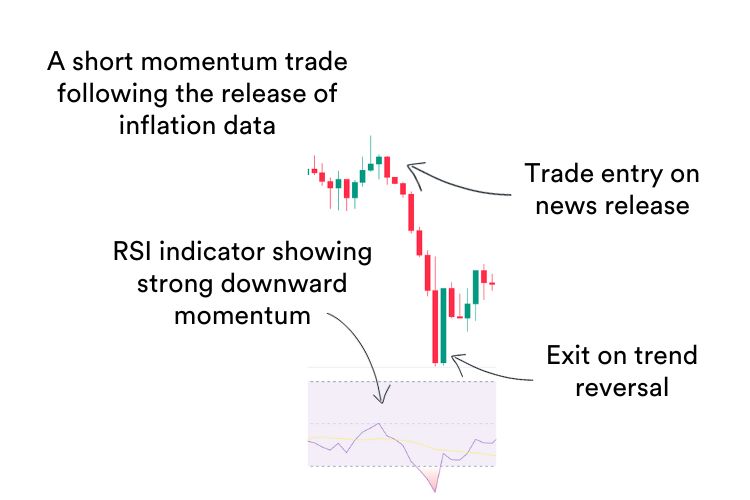
4. Momentum trading strategies
Momentum trading involves trading a pair that is moving strongly in one direction with significant volume.
This strategy capitalises on the momentum of the market to achieve profitable trades.
It’s a common strategy used by forex traders around key data releases, such as interest rate and Federal Reserve announcements.
However, it’s usually a short-term trading strategy that may only last a few minutes or hours.
How it works:
- Identify momentum: Use a momentum indicator like the Relative Strength Index (RSI) or Moving Average Convergence Divergence (MACD) indicator to identify strong trends, including overbought and oversold conditions
- Enter the trade: Buy when the momentum is strong in an upward direction, and sell when the momentum is strong in a downward direction
- Ride the trend: Stay in the trade as long as the momentum remains strong, remaining vigilant for signs of a reversal pattern
- Set a stop-loss order: Use a trailing stop-loss order to lock in your profits and protect you when the reversal does happen
- Exit the trade: Exit the trade when momentum indicators signal a potential reversal or the trend appears to be at its end

5. Scalping strategies
Scalping is a high-frequency trading strategy that aims to profit from small price changes.
Traders using this strategy typically hold positions for a very short duration, ranging from seconds to minutes.
Many algorithmic traders (using high-speed computers or AI algorithms) use scalping strategies. If you try this strategy you’ll be trading alongside the fastest computers, and most experienced traders in the world.
How it works:
- Identify opportunities: Use technical analysis, candlesticks and short-term charts to find potential trading opportunities (ie. one-second to one-minute charts)
- Enter and exit quickly: Enter and exit trades quickly to capture small profits. This requires quick decision-making, precision in reading charts and speedy trade entry
- Manage your risk: Use tight stop-loss orders to limit losses. Given the high frequency of trades, effective risk management in forex trading is crucial
- Focus on liquidity: Trade highly liquid instruments to ensure quick execution and minimal slippage
Is scalping a suitable trading strategy for beginners?
Scalping is not a strategy I would recommend for novice traders, as it requires a high degree of concentration and experience to scalp profitably.
When I was day-trading, I’d occasionally use a scalping strategy if I was at the peak of my mental health and performance.
I’d think of it like I was out for a leisurely jog, and suddenly felt the urge to do a 100-metre sprint, just to get my cardiovascular system pumping.
At the end of a two or three-hour scalping session, I’d be physically exhausted. I’d then change back to my more sustainable and usual ‘jogging pace’ of trading.
But I’ll admit I did enjoy the occasional rush of adrenalin, and by that time I had developed the necessary skills and experience to scalp successfully.
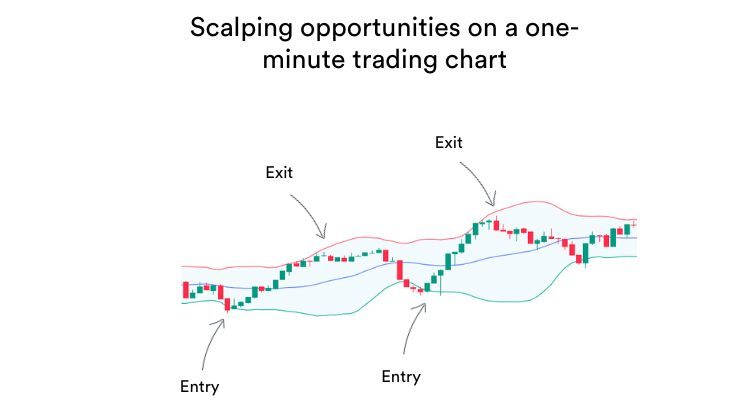
The example below shows scalping opportunities on a one-minute chart, showing two long-trade entries and exits in less than 45-minutes.

6. Macro trading strategies
How they work:
Macro trading (meaning wide-view or large-scale) tends to involve a longer time-frame, days and weeks rather than hours or days.
It involves getting really familiar with how the whole financial world ticks, and then using that knowledge to place profitable trades.
The steps involved are:
- Global economic analysis: Macro trading involves analysing macroeconomic trends and policies. Use GDP growth rates, inflation, unemployment and interest rates to identify trends and trading opportunities. Keep a close eye on the bond market, as the movements in this market are inextricably linked to forex market behaviour
- Market selection: Based on your macroeconomic analysis, decide which pairs to trade and when. This could involve long or short positions depending on the economic trends you have identified
- Monitoring of central banks: Central bank policies, such as changes in interest rates and quantitative easing, are crucial indicators for macro traders. These policies significantly impact currency values and interest rate differentials
- Understanding geopolitical events: Political instability, international trade agreements, and other geopolitical events will also influence macro trading decisions. All these can have significant impacts on economies and markets.
Macro trading requires a deep understanding of global macroeconomics, strong analytical skills, and the ability to interpret and anticipate market-moving events on a global scale.
It is most suited to longer-term traders and investors who take a ‘big-picture’ view of wealth accumulation.
7. Carry trading strategies
How it works:
This strategy involves buying one currency with a low interest rate, and funding the purchase of a higher-interest-rate value currency.
- Interest rate differentials: Borrow in a currency with a low interest rate (such as the Japanese yen or Swiss franc) and invest in a currency with a higher interest rate to profit from the interest rate differential
- Currency pairs: Focus on pairs with significant interest rate differences, such as borrowing Japanese yen (low interest) and investing in Australian dollars (high interest). Other common pairs used for carry trades include AUD/USD, NZD/USD and USD/CAD
- Benefit from currency appreciation: Benefit from both the interest rate differential and potential appreciation of the higher-yielding currency
- Manage your risk: As with all trading strategies, use tight automatic stop-loss orders to limit any potential losses
- Risk of reversals: Monitor economic indicators and central bank announcements closely to avoid losses from sudden shifts in exchange rates or interest rate policies
Swap fees / rollover fees on carry trades
In forex trading, the fees associated with holding a position overnight are commonly referred to as swap fees or rollover fees.
These fees arise from the interest rate differential between the two currencies in a currency pair.
Depending on whether the interest rate of the currency you are buying is higher or lower than the currency you are selling, you may either earn or pay a fee to hold your position open overnight.
- Interest rate differential: The fee is based on the difference in interest rates between the two currencies in the currency pair
- Positive carry: If you are holding a currency with a higher interest rate than the one you borrowed, you may earn interest
- Negative carry: If you are holding a currency with a lower interest rate than the one you borrowed, you may pay interest
- Calculation: The fee is calculated and applied by your broker at the end of the trading day, typically around 5 p.m. New York time, which is considered the end of the trading day in forex markets.
Examples of carry trades:
- EUR/USD pair: If the interest rate for the euro (EUR) is lower than the interest rate for the US dollar (USD), you would pay a swap fee if you are long EUR/USD (buying EUR and selling USD).
- NZD/JPY pair: If the interest rate for the New Zealand dollar (NZD) is higher than the interest rate for the Japanese yen (JPY), you would earn a swap fee if you are long NZD/JPY (buying NZD and selling JPY).
8. Contrarian trading strategies
Contrarian trading (or going ‘against the trend’) was made famous by such legendary traders as Warren Buffett and George Soros.
This form of trading can be highly profitable, but it requires a deep understanding of market psychology, rigorous analysis, and disciplined risk management.
Therefore, this strategy is not recommended for beginners due to the risks involved in going against the trend.
However, for experienced traders who are in tune with their own trading psychology, it offers the potential for substantial rewards by capitalising on market overreactions.
How to develop a contrarian strategy:
- Market sentiment analysis: Assess market sentiment to identify overbought or oversold currency pairs
- Identifying extremes: Use technical analysis indicators like the Relative Strength Index (RSI) or moving averages to spot extreme price levels and potential reversal points
- Fundamental analysis: Perform fundamental analysis to determine if a currency is undervalued or overvalued based on economic data
- Taking opposite positions: Short the currency in a bullish market, expecting a downturn, or go long in a bearish market, anticipating a rebound
- Patience and timing: Be patient, as markets can stay irrational longer than expected. Proper timing and a willingness to hold positions until the market corrects are essential
- Risk management: Employ stringent risk management practices to protect against prolonged adverse price movements, given the inherent risk of opposing the trend.
9. News trading strategies
A forex news trading strategy involves making trading decisions based on the release of economic data, major news events, or significant geopolitical developments.
This approach allows you to capitalise on the immediate market reactions to these events, often leading to sharp price volatility and potential profit opportunities.
How it works:
- Monitor news events: Keep a close watch on the economic calendar for scheduled news releases such as central bank interest rate decisions, GDP reports, employment data, and other key economic indicators
- Analyse the impact: Before the news is released, analyse the potential impact of the news on currency pairs. Consider both the expected and actual outcomes of the news
- Positioning: Based on your analysis, take positions in the forex market just before or immediately after the news release. Go long or short depending on whether you expect the news to positively or negatively affect the currency
- React quickly: React quickly to the news, as the market can move rapidly within seconds of the announcement. This requires the use of a high-speed trading platform, and highly-efficient order execution
- Volatility exploitation: The strategy aims to exploit the increased volatility that typically follows major news events. This can result in significant price movements, providing opportunities for substantial gains
- Tight risk management: Due to the high risk associated with news trading, implement robust risk management practices. Set stop-loss orders to limit potential losses and use appropriate position-sizing
An example of a news trading strategy
Non-Farm Payrolls (NFP) Report
One of the most watched economic indicators in forex trading is the US Non-Farm Payroll report, released on the first Friday of every month.
This report provides data on the employment situation in the US, excluding the farming industry, Federal Government employees and nonprofit organisations.
It provides figures for the total monthly increase or decrease in paid U.S. workers across most businesses.
- a higher-than-expected NFP figure typically strengthens the USD (but gives rise to inflation concerns)
- a lower figure weakens the USD (and reduces the chances of an inflation rate rise)
Before the release: Analyse forecasts and market sentiment regarding the NFP numbers
Positioning: Based on your analysis, take positions in USD pairs, such as EUR/USD, anticipating how the market will react
Post-release: Once the NFP data is released, quickly adjust your positions based on the actual figures, capturing the immediate price movement
Best forex trading strategies for beginners
There is no such thing as one single best trading strategy for a beginner forex trader.
This is because the best strategy for you to use will depend on the type of trader you wish to become.
There’s no such thing as ‘one trading strategy fits all’ in the world of forex trading.
It’s a bit like asking ‘which clothes are best to wear?’
It all depends on your individual circumstances, the trading conditions you face, and the type of person you are.
Final thoughts about forex trading strategies
Mastering a number of different trading strategies can significantly enhance your trading performance and profitability.
Each strategy has positives and negatives, and is suited for different market conditions and trading styles.
By gaining a deep understanding of how all these different strategies are used, you can make a decision about which trading strategy appeals the most to you.
Remember to take lifestyle considerations into consideration, such as:
- how often you intend to trade
- how much time you have available each trading session
- at what stage of the forex trading cycle you are able to trade
when making your decision.
I’d suggest at first you choose one trading strategy, and try using it with one currency pair, before branching out to other strategies or pairs.
The more forex trading strategies you become familiar with, and know how to use, the more tools you’ll have in your toolbox ready to trade any market condition.
Free resources to assist you
We have a range of handy MarketMates’ resources to assist you with your trading that you can access 100% FREE.
These include:
- A comprehensive but simple-to-use Trading Plan Template
- A Trader’s Compass Template, which is another planning document aimed to help you take your trading to the next level
- A Contingency Plan Template, which will help you plan how to deal with unexpected events
- A Trade Recording Spreadsheet, which will help you keep a record of all your trades. It will assist with the maths involved in monitoring and calculating your performance
You can access all these useful FREE resources on our MarketMates Resources Page.
For example, this is the start of the Trader’s Compass template.

If you’d like more information about forex trading at a basic level, read my trading course for beginners.
Or, alternatively, if you wish to take your forex trading up to the next level, why not sign up for the MarketMates’ ‘Advanced Forex Course for Smart Traders 2.0?
In this 17-lesson FREE course, my colleague (and MarketMates co-founder) Sam Eder takes you through every aspect of developing a forex trading plan, step-by-step.
By the end of this course, you’ll end up with a comprehensive trading plan covering your trading objectives, the strategies you’ll use, your risk management parameters, and much more.
It’s your free, complete and comprehensive guide to becoming a consistent, confident rules-based trader.
Till next time, happy trading!

If you like this article then sign-up for our newsletter or join over 42,000 traders and get The Advanced Forex Course for Smart Traders 2.0. It’s 100% free.
Sources
Marketmates uses only high-quality sources, including peer-reviewed studies, to support the facts within our articles. Read our editorial guidelines to learn more about how we fact-check and keep our content accurate, reliable, and trustworthy.
- Sam Eder – The Consistent Trader https://www.amazon.com.au/Consistent-Trader-Winning-Trading-Psychology/dp/1631610252
- Investopedia – Trading Strategies https://www.investopedia.com/trading-strategies-4689646#:


