Fact checked

At MarketMates, we are committed to providing accurate information. Our content undergoes a rigorous process of fact-checking before it is published. Learn more about our editorial policy.
Last updated on June 25th, 2025
  Written by 
Sam Eder

Author

Sam Eder
Sam is the cofounder and CEO of MarketMates. He has worked for brokers since 2008 and is the author of the Amazon best-seller 'The Consistent Trader.' His 'Advanced Forex Course for Smart Traders' has over 45,000 students.
Our authors

Top 20 Lessons Learnt From Day Trading USDJPY

Here's the Top 20 lessons I've learnt about trading USDJPY after years of experience and trial and error

5 ChatGPT Prompts to Help You Pass Any Prop Firm Challenge

Build a rules-based plan in minutes using AI.

In this article

Secure Broker-backed Funding for Traders.

Try simple, flexible ‘balance-based’ challenges. 

MarketMates Logo

The MarketMates promise

At MarketMates, we are committed to providing accurate information. Our content undergoes a rigorous process of fact-checking before it is published. Learn more about our editorial policy.

In this article

For the past three years of my 16-year forex trading career, I’ve been day trading USD/JPY. In that time I’ve done a great deal of USD/JPY analysis.

During this time I learnt a lot of valuable lessons, and it’s these lessons I’m going to share with you today. 

My USD/JPY trading method

I didn’t trade all the time.

I counted 22 months of trading USD/JPY during this period, for a 3% return per month, with 75% winning months.

I use a ‘rules-based’ approach to trading, and trade on my iPhone in the evenings.

These are the lessons I learnt that I’ll share with you:

Lesson #1: Use a simple technical strategy

To trade USD/JPY I use an uncomplicated trading strategy with two common indicators – the Bollinger Bands, and a couple of custom indicators (Bollinger Bands and RSI) which we have developed here at MarketMates. 

If you use TradingView as your charting program, you can find the indicators here for free. 

I look for a period of consolidation, and then wait for the price to break out.

I have a few easy-to-follow rules about when to take profit.

Here is my chart setup:

Simple technical strategy

I’m not trying to imply that it’s always as easy as that, rather that you can trade USD/JPY just using charts.

This simplicity leads to a clear mind, which is important.

Lesson #2: You can trade part-time on your phone

Because of this simple approach to trading, I don’t use a fast news feed or a multi-screen computer setup.

Instead, I use alerts on my phone. I have an app that reminds me to look at the markets every fifteen minutes from 7pm to 11pm.

I add alerts on the chart, so that if the price breaks out or my indicator gives a signal to do something then I’m notified. This is important, as it’s easy to get distracted and miss trades.

TradingView is great for setting up alerts and allows me to trade using only my iPhone with a TradingView chart and my broker app for order execution.

Lesson #3: Trade only one market

I only trade USD/JPY. This is because when I first started day trading I also traded EUR/USD. However, I found two markets to be too much for me.

I found I was losing twice as much in one day, which I found could be stressful.

So, by keeping to one currency pair, I found my trading was simplified and as a result, my confidence grew.

Trading just one currency pair, I got to know USD/JPY very well and began to recognise it’s daily patterns.  

Lesson #4: Trade once a day

I limit myself to trading once a day between 7pm – 11pm. After my first trade is complete I end my trading for the day.

This is important for limiting drawdowns in my trading account, and avoiding overtrading during choppy markets.

Lesson #5: Cut your losses quickly

For my trading, I focus on being a good risk manager.

When I first started trading this strategy, I had a set stop-loss of 11 pips and I targeted at least four times that in profit.

This meant I was getting out of losing trades quickly and I would have some large profitable trades.

However, this approach did not adapt well to changing market conditions, and so now I use stops based on the Average True Range (ATR) indicator (more on this later). 

Whichever method I use, what’s important is to cut my losses and let my profits run. 

Lesson #6: Sometimes you lose

By day trading with a tight stop-loss, I became experienced at dealing with losing trades.

Occasionally, I have three or more losing trades in a row.

What matters is not how many losers you have in a row, but the total profitability over a longer period.

By being comfortable with taking losses, I remain in the market and benefit from the highly profitable trades I make.

You can see an example in my trading statement of this pattern where I take several losses or breakeven trades in a row before I have a winner.

Statement example

Lesson #7: Mistakes hurt, but move on quickly

In 2023, I had the most difficult period of day trading.

I missed a winning trade because I was distracted, and this led to me making a series of trades where I altered my trade size in contravention of my own trading rules. 

I gave back much of the profit I had made for the year.

If I had just kept trading normally, I would have recovered and not experienced those losses. 

Mistakes hurt, but you can’t do anything about them once they have happened. There is no going back in time, and it’s best to put them out of your mind and move forward.

Lesson #8: Take some profit to increase consistency

When I first started day trading, I had a simple exit plan. I set a 55-pip target and I would exit before my target was hit if USD/JPY got overbought or oversold.

While having one target was profitable, it often meant I would experience longer losing streaks. 

Later, I decided to split my position into four parts. This way I take a little bit of profit off the table and still leave some in the trade for when the trade goes in my favour. 

This reduces the number of losses I have in a row and leads to larger overall profits.

Lesson #9: Exit on strength

Earlier in my trading career, I had a lot of profitable trades that turned around and ended up as losers.

I fixed this issue by taking some profit when the currency pair gets overbought or oversold and begins to reverse.

I use an indicator for this, so it’s not subjective.

Here is a snapshot:

Take profit on strength

This allows me to exit part of my trade near the peak.

Lesson #10: Move your stop to breakeven

It’s a nice feeling when you have a winning trade and your stop-loss is at breakeven. This means you have nothing to lose on the trade.

I found this gives me peace of mind as I don’t worry about my trade turning into a loss.

I am careful not to move the stop too early and wait until the trade has gone in my favour, otherwise, I can get knocked out of a winning trade too easily.

Lesson #11: Keep your trade on during news events 

My strategy around news events is simple.

If I am in a trade, I don’t take any action. Sometimes I get stopped out, but more often than not, the news ends up pushing the trade in my favour.

I don’t enter trades directly after a news event. I tried this for a while and it has a low win rate.

Lesson #12: What to do if the trade just misses your target

There is nothing more annoying than if your trade almost hits your target.

Something I learnt from the late Dr Van Tharp years ago was to close out trades that get close to your target and don’t let them reverse to the stop-loss point. 

This requires fast fingers!

I close the trade if it gets within 2 pips of the target and hangs there, or within 3 pips and reverses by 2 pips (i.e. 5 pips below my target).

I set an alarm just below my target to alert me when the price is close. This has saved me a fair few times.

Lesson #13: Pay commission not spread

It is much better to have a trading account that does not have a spread markup.

If you have a wider spread your targets get hit less and your stops get hit more.

This is because if you have a wider spread the price is further away from your target and closer to your stop-loss. 

Because of this, it’s much better to use a spread and commission account. 

Most of my trades on USD/JPY have a spread close to 0.0 so the trade needs to move against me the full number of pips before I get stopped out.

Lesson #14: Keep your risk amount consistent

I risk the same amount on every trade. 

For example, I risk 1% of my account per trade no matter how far the stop is. This is my 1R risk. 

With consistent risk amounts, it is clear each day how much I can lose or win, depending on how well my trades go.  

Lesson #15: Trade with the trend

The best times to trade are when the underlying trend is strong. 

I look at the daily charts to determine the direction. 

In the past, I would take the first trade of the day no matter the direction. 

With experience, I learnt to be patient and wait for a trade in the direction of the trend. 

Lesson #16: Change your trading rules once a month

It’s easy to experience recency bias when you trade. This means you place more emphasis on recent trades, compared to older trades.   

To avoid recency bias I only change my rules once a month.

This way I am slowly adapting and improving my trading over time without over-reacting to recent wins or losses.

If you are just starting to develop your trading plan, you can plan to make changes every fortnight, but don’t make changes frequently or rashly.

Lesson #17: Limit discretion

When I started day trading, I would use candlesticks to exit trades. 

However, in time I found it was better to use a non-discretionary rule instead. 

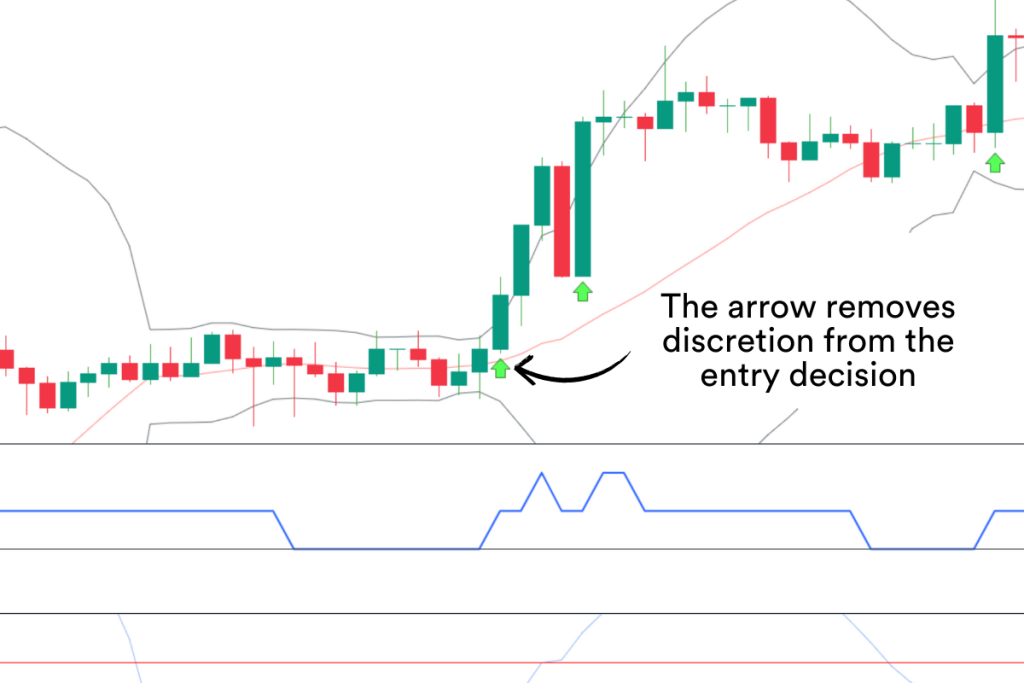
For example on the chart below you will see there is a big arrow drawn by the indicator when the price crosses the Bollinger Bands.

This is one of the indicators you can get for free in the MarketMates Indicator Pack. 

The green arrow provided by this indicator completely removes any discretion from the entry decision.

Bollinger Bands Entry

Lesson #18: Let your profits run

There were several times when I had a good trade that hit my profit target, and I closed the entire trade. 

Having closed the whole trade, the currency pair continued to move in my direction, so I lost out on potential profit.  

Catching some of these big moves can make a huge difference to your trading account. 

Therefore, one of the changes I made to my trading plan was to add  rules that allowed a portion of my profit to run.

Lesson #19: Use volatility-adjusted stop-losses and targets

Another change I made to my trading plan was to have volatility-based stop-losses and targets.

After analysing a large number of my trades, I realised there were periods where my stop-loss was too close or my targets were too far away. 

This was due to overall increases or decreases in volatility. 

Now I use the ATR indicator to measure how far my stop-loss and targets should be.

As mentioned above, I adjust my position size so my risk remains consistent, no matter what my stop distance is.

Lesson #20: Rehearse the trading day in advance

I practise two simple mental techniques to assist me to be in the best frame of mind when making trading decisions.

These techniques only take a few minutes and help me to avoid making mistakes;

  1. I practise conscious breathing during the last minute leading up to a trade
  2. Before bed each night, I take deep breaths and mentally rehearse exactly following my trading rules.

I find these techniques powerful and efficient ways to stay disciplined.

Over to you

I hope the lessons that I have shared with you will assist you in your trading. 

I would encourage you to pick two or three that resonate with you, and implement them in your trading plan.

Try this on several trades, and be consistent.

Do a month of trading based on the lessons and then take a step back and assess.

This way you can confirm if they are a fit for you.

Cheers,

Sam Eder signature

If you like this article then sign-up for our newsletter or join over 42,000 traders and get The Advanced Forex Course for Smart Traders 2.0. It’s 100% free.

Secure Broker-backed Funding for Traders.

Try simple, flexible ‘balance-based’ challenges. 

Picture of Sam Eder

Sam Eder

Sam is the cofounder and CEO of MarketMates. He has worked for brokers since 2008 and is the author of the Amazon best-seller 'The Consistent Trader.' His 'Advanced Forex Course for Smart Traders' has over 45,000 students.
Picture of Sam Eder

Sam Eder

Sam is the cofounder and CEO of MarketMates. He has worked for brokers since 2008 and is the author of the Amazon best-seller 'The Consistent Trader.' His 'Advanced Forex Course for Smart Traders' has over 45,000 students.

5 ChatGPT Prompts to Help You Pass Any Prop Firm Challenge

Build a rules-based plan in minutes using AI.

The Advanced Forex Course

for Smart Traders 2.0

Join over 42,000 traders and get FREE access to 17+ lessons and five hours of on-demand video based on the famous ‘Market Wizards’.

Keep Learning

Bank Desk Weekly
Sam Eder

Bank Desk FX Weekly 24 August 26

The US dollar remains under pressure, but this week could decide whether the weakness has further to run. PCE inflation and Fed Chair Kevin Warsh at Jackson Hole are the

Bank Desk Weekly
Sam Eder

Bank Desk FX Weekly 17 August 26

The US dollar starts the week under pressure as weaker jobs, inflation and retail data reduce expectations for another Fed rate increase.

Bank Desk Weekly
Sam Eder

Bank Desk FX Weekly 10 August 26

Weak US jobs have pushed the dollar lower and reduced expectations for further Fed rate hikes. Banks remain divided on what comes next, with US CPI, the RBA decision and

marketmates

Join over 42,000 Traders. 100% FREE.

The Advanced Forex Course
for Smart Traders