


Forex trading is a truly global marketplace, the largest financial market in the world.
Unlike traditional stock markets, forex trading operates 24-hours a day, five and a half days a week, allowing traders to capitalise on trading opportunities almost 24/7 regardless of their time zone.
However, not all trading hours are created equal. Understanding the different trading sessions around the world can help you optimise your forex trading.
Forex market trading hours
Activity in the forex market isn’t uniform throughout the day. It’s divided into four major trading sessions based on the financial centres that dominate each period.
However, unlike stock markets, which have defined opening and closing hours, there are no such definitive trading hours for forex. This is why it is described as a 24-hour market.
It is important to check on your trading charts for opening and closing session times relevant to your part of the world, as changes in market times occur twice a year due to daylight savings.
Market opening times often coincide with sharp price reversals and volatile price action, which is another reason why it’s important to be aware of session opening and closing times.
The chart below shows some of the extreme volatility you can expect to see at the opening of a market session – in this case the US session.


Global forex trading hours
Forex trading is divided into four major sessions:
- the Sydney session (also known as the Australian session, which includes New Zealand)
- the Tokyo session (also known as the Asian session, including Singapore, Japan and China)
- the London session (also known as the European session)
- the New York session (also known as the US session)
The diagram below shows the various session opening hours in global UTC time, and how the four main forex sessions overlap.

Forex session hours – UTC
- Sydney is open from 9.00pm to 6.00am UTC
- Tokyo is open from 11.00pm to 8.00am UTC
- London is open from 8.00am to 4.30pm UTC
- New York is open from 1.00pm to 9.00pm UTC
Forex session hours – days and times of the week
Opening and closing hours:
The global forex market opens at 9.00pm Sunday night UTC, and closes at 9pm on Friday night UTC. These are the equivalent opening and closing hours in local time for each region:
Sydney
Open: 6.30am Monday morning (AEST)
Close: 6.30am Saturday morning (AEST)
London
Open: 9.00pm Sunday night (GMT)
Close: 9.00pm Friday night (GMT)
Tokyo
Open: 6.00am Monday morning (JST)
Close: 6.00am Saturday morning (JST)
New York
Open: 4.00pm Sunday afternoon (EST)
Close: 4.00pm Friday afternoon (EST)
These are the opening hours of the four main forex sessions around the world in local time:

Daylight savings time (DST)
The open and close times of these forex sessions also changes in some countries (relevant to UTC) twice a year, due to daylight savings time.
These changes occur during March/April when clocks go forward, and again in October/November when clocks are put back, usually for an hour each time.
Countries that do have daylight savings include the US, the UK, Australia and New Zealand.
Forex traders need to be aware of daylight savings time changes, and to adjust their trading hours accordingly.
When is the best time to trade?
The forex market never truly sleeps during weekdays. There’s always a session running somewhere in the world.
However, some sessions are livelier than others. This is why timing your trades is important.
Quiet vs. active sessions
Imagine a marketplace. When only one shop is open, things might be slow. Similarly, when just one forex session is active, trading volume can be low.
There are fewer people buying and selling currencies, leading to less movement in prices.
Overlap is the key
The real action often happens when two major financial centres overlap. Think of it as two busy marketplaces merging.
Suddenly, there are a lot more traders participating, buying and selling currencies.
This increased activity can lead to higher trading volume and potentially more significant price movements.
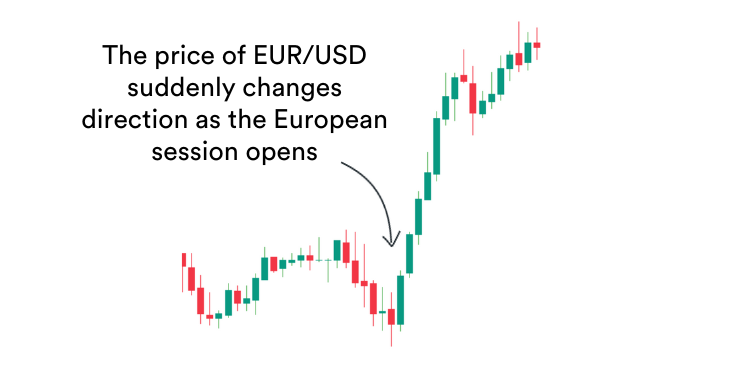
The example below shows a sudden change in direction of price movement just as the European forex session opens for the day:

London and New York take centre stage
Peak forex trading activity occurs when the London and New York sessions overlap.
Imagine the busiest markets in both cities buzzing with activity. It’s no surprise that over half of all forex trading volume happens during this time.
They overlap for about four to five hours in every 24-hour period, Monday to Friday.
There are just two public holidays per year when the entire forex market is closed, which are Christmas Day (December 25th) and New Year’s Day (January 1st.)
Forex session market overlap hours
The Australian Session
The Australian forex trading session kicks off the global forex market, overlapping with the beginning of the Asian session.
The Sydney session, also sometimes referred to as the Oceania session, encompasses business hours in Australia and the early morning in New Zealand.
Major trading centre
Sydney, Australia
As the financial capital of Australia, Sydney kicks off the forex trading day globally.
While not as prominent as other financial centres, Sydney sets the stage for the day’s trading activities in the Asia-Pacific region.
Despite its relatively small trading volume compared to other sessions, the Australian session sets the tone for the day’s trading around the globe.
Compared to the heavyweights like London and New York, the Sydney session is less active in terms of trading volume. However, this doesn’t mean there’s no action.
Here’s what you can expect:
A focus on the Aussie dollar (AUD)
As you might guess, the AUD takes centre stage during this session. Traders watch economic data releases and news events from Australia and New Zealand that might impact the AUD’s value.
Carry trade strategies
The Sydney session can be a good time for carry trade strategies, which involve exploiting interest rate differentials between currencies.
Since Australia and New Zealand tend to have higher interest rates compared to some other major economies, traders often borrow in a low-interest-rate currency and invest in the AUD or NZD to pocket the interest rate difference.
Overlap with the Asian session
The Sydney session starts just a couple of hours before the Tokyo session.
This can sometimes lead to increased volatility, especially for the AUD/JPY pair, as the Asian traders enter the market.
The chart below shows how USD/JPY is affected as the Tokyo session opens and many new traders enter the market.


New Zealand in the mix
While the Australian Dollar is the main focus, the New Zealand Dollar (NZD) also plays a role in the Sydney session.
Since New Zealand’s economy is closely linked to Australia’s, economic data releases from New Zealand can also influence the AUD and NZD during this time.
The Asian Session
The Asian session is the first major session to fully open, encompassing financial hubs like Tokyo, Singapore, and Hong Kong.
Major trading centres
Tokyo, Japan
Tokyo is a major financial hub in Asia and the world, contributing significantly to forex trading volume during the Asian session. It is known for its active trading in currency pairs involving the Japanese yen (JPY).
Singapore
Singapore is the fastest growing financial centre in Southeast Asia, with a strong presence in the forex market.
It serves as a gateway for trading activities in the region, attracting traders from across Asia. Here you can read about how to find the best forex broker in Singapore.
Hong Kong
Hong Kong plays a crucial role in the Asian forex trading session, with its proximity to mainland China and its status as an international financial hub.
It is a key player in trading activities involving the Chinese yuan (CNY) and the Hong Kong dollar (HKD).
This session is known for its liquidity, particularly during the overlap with the Australian session.
It is also known for its focus on the Japanese Yen (JPY) and the Australian Dollar (AUD).
This is due to the dominance of Japanese financial institutions and Australia’s close proximity to Asia.
The Asian session sees increased activity in currency pairs involving the Japanese yen (JPY), such as USD/JPY and AUD/JPY.
Currency pairs to trade
AUD/JPY, USD/JPY, EUR/JPY, AUD/USD.
The focus for Asian traders
Since the session overlaps with the end of the New York session, Asian traders often react to news and data releases from the US that might have impacted markets overnight.
They might also focus on economic data releases from China and Japan during this time.
Hong Kong Session
While not considered a separate trading session, the Hong Kong market operates during the Asian session and is a significant contributor to forex trading volume.
Traders pay close attention to developments in the Chinese economy and its impact on currency pairs like USD/CNY.
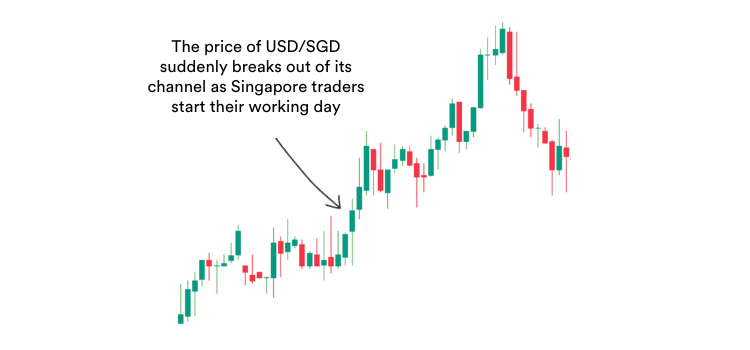
The chart below shows a sudden breakout in USD/SGD as Singapore traders start their working day.

The European Session
The European session is the most active forex trading session, with London as its primary financial hub.
The London session is the most active and liquid session due to the concentration of major banks and financial institutions in London.
The widest range of currencies are traded here.
Major trading centres
London, United Kingdom
London is the largest and most influential financial centre in the world, dominating the European forex trading session. It is home to major banks, hedge funds, and financial institutions, driving high trading volume and liquidity in the market
Frankfurt, Germany
Frankfurt is a major financial hub in Europe, particularly for forex trading in the Eurozone.
It hosts the European Central Bank (ECB) and plays a significant role in shaping monetary policy and market sentiment
Zurich, Switzerland
Zurich is renowned for its banking and financial services sector, contributing to the liquidity of the European forex market. It is a key player in trading activities involving the Swiss franc (CHF)
As the busiest forex trading session in the world, the European session sees high liquidity and volatility, making it ideal for day traders and scalpers.
Major currency pairs like EUR/USD, GBP/USD, and EUR/GBP experience increased trading volume during this session.
Currency pairs to trade
EUR/USD, GBP/USD, USD/CHF, EUR/JPY, AUD/USD
Focus for European traders
European traders react to economic data releases from the Eurozone and the UK, along with global news events that might impact currency valuations.
This session also sees significant participation from Middle Eastern and African traders.
In this chart we see a new price trend developing in EUR/USD (after a quiet period of consolidation) just as the European session opens.


The US Session
The US session, centred around New York, is the final major trading session of the day. It overlaps with the end of the European session.
The working hours of the New York Stock Exchange marks the most active period for forex trading within a 24-hour time period, as this is the largest stock exchange in the world.
This results in heightened volatility, as traders in both regions react to economic data releases and geopolitical events.
Major trading centres
New York City
New York City is the financial capital of the world, hosting the New York Stock Exchange (NYSE) and the Federal Reserve Bank of New York.
As the financial hub of the United States, New York hosts numerous large financial institutions, hedge funds, and investment banks.
It drives the majority of forex trading volume during the US session, with active participation from banks, hedge funds, and institutional investors.
Chicago
Chicago is another important trading centre in the US session, known for its derivatives and futures markets.
The Chicago Mercantile Exchange (CME) is a key player in the global forex market, offering various forex futures and options contracts.
Chicago’s strategic location and financial infrastructure make it a vital hub for forex trading in the US trading session.
Toronto
Toronto is a major forex trading hub in Canada, playing a crucial role in the North American forex market.
As Canada’s financial capital, Toronto is home to the Toronto Stock Exchange (TSX) and several major banks and financial institutions.
Canadian traders actively participate in the US session, contributing to the overall market liquidity and trading volume.
Canadian traders benefit from the overlap between the US and European sessions, which provides access to high liquidity and volatility.
Trading during the US session allows Canadian traders to take advantage of major economic releases from both the US and Canada, such as employment reports and central bank announcements.
Currency pairs to trade in the US session
Currency pairs involving the US dollar (USD) are particularly active during this session, including EUR/USD, USD/JPY, and GBP/USD.
Understanding the financial hubs involved in each trading session provides valuable insights into market dynamics, liquidity, and trading opportunities.
Focus for US forex traders
American traders focus primarily on economic data releases from the United States, which can significantly influence the value of the US dollar and other currency pairs.
Key events include the release of non-farm payrolls, GDP figures, and Federal Reserve announcements.
Additionally, traders monitor economic developments in Canada, as the USD/CAD pair is heavily traded.
Global news events and market sentiment from the European trading session can also impact the American trading session.
The chart below shows how the opening of the US market suddenly changes the price direction of GBP/USD.


International Market Hours Calculator
If you want to check the exact market opening hours for the region where you live, you can use this handy market hours calculator:
Final thoughts
The forex market operates around the clock, 24-hours a day, 5.5 days a week.
As the US market winds down, the Australian and Asian markets kick-off, followed by the European markets, creating a continuous trading cycle until the weekend break.
This flexibility permits traders to accommodate forex trading into their life schedule, balancing other responsibilities like work, family, or study.
For beginners, it’s best to select a specific time of the day and week that suits your routine, and make this your dedicated trading period.
Choose a major forex pair relevant to your trading session, and get really familiar with its unique characteristics.
You should get to intimately know everything about how your chosen trading session works – what influences it, when it tends to get volatile, and it’s quietest times, too.
Don’t make the rookie mistake of trying to trade multiple pairs in different sessions all at once.
It’s best to focus on one pair and one session to hone your trading skills before trying another pair or session.
The best advice we can give you is learn to master the basics well before moving on to more complex trading.
Forex trading is available at any convenient time, day or night.
Until we meet again, happy trading!

If you like this article then sign-up for our newsletter or join over 42,000 traders and get The Advanced Forex Course for Smart Traders 2.0. It’s 100% free.
Sources
Marketmates uses only high-quality sources, including peer-reviewed studies, to support the facts within our articles. Read our editorial guidelines to learn more about how we fact-check and keep our content accurate, reliable, and trustworthy.
- Investopedia – The Best Times To Trade Forex. https://www.investopedia.com/articles/forex/08/forex-trading-schedule-trading-times.asp


