Fact checked

At MarketMates, we are committed to providing accurate information. Our content undergoes a rigorous process of fact-checking before it is published. Learn more about our editorial policy.
Last updated on February 28th, 2025
  Written by 
MarketMates Editorial Team
The MarketMates editorial team is led by ceo and co-founder Sam Eder, and consists of internal and external trading experts.
Our authors
  Reviewed by 
Sam Eder

Reviewer

Sam Eder
Sam is the cofounder and CEO of MarketMates. He has worked for brokers since 2008 and is the author of the Amazon best-seller 'The Consistent Trader.' His 'Advanced Forex Course for Smart Traders' has over 45,000 students.
Our authors

Trading Course for Beginners

From currency pairs to trade strategies, find out everything you need to know here with MarketMates' trading course for beginners

5 ChatGPT Prompts to Help You Pass Any Prop Firm Challenge

Build a rules-based plan in minutes using AI.

In this article

Secure Broker-backed Funding for Traders.

Try simple, flexible ‘balance-based’ challenges. 

MarketMates Logo

The MarketMates promise

At MarketMates, we are committed to providing accurate information. Our content undergoes a rigorous process of fact-checking before it is published. Learn more about our editorial policy.

In this article

Forex trading involves buying and selling currency with the aim of  making a profit. It is one of the most popular forms of trading in the world.

As of late 2024, it’s estimated there are over 10.5 million forex traders in the world, and this number continues to grow daily.

In forex trading course for beginners, we take a detailed look at all aspects of trading with an emphasis on helping beginners with little money.  

What is forex trading?

Forex trading, also known as foreign exchange trading or currency trading, involves the buying and selling of currencies on the foreign exchange market.

It is the largest and most liquid financial market in the world, with an estimated US $7.5 trillion traded daily.

A line graph showing the increase in volume of forex trading from 1998 to the present year 2024

Forex trading allows individuals, institutions, and businesses to speculate on the value of one currency against another, and profit from fluctuations in exchange rates.

Most people trade forex using CFDs (Contracts for Difference.) 

How does forex trading work?

The forex market is not like a conventional stock exchange.

Rather, it consists of a network of banks, financial institutions, brokers, and individual traders, all interconnected through electronic trading platforms.

It operates 24-hours a day, five days a week, although given the different world time zones, it’s possible to trade forex almost 24/7. You can find out the best times to trade here. 

Retail forex trading plays only a small part in the overall forex market.

It is estimated that retail traders represent less than 5% of the overall forex market. 

A diagram showing the volume of retail fx trading compared to the overall forex market

Time zones for forex trading

There are four major forex trading sessions, categorised by their time zones:

  1. Sydney Session (Sydney Time – GMT+11): Often referred to as the ‘Asia-Pacific session,’ this session opens the forex trading day. While liquidity might be lower compared to other sessions, the session can be volatile due to economic data releases from China, Japan, and Australia.
  2. Tokyo Session (Tokyo Time – GMT+9): This session overlaps with the latter part of the Sydney session. It is a major hub for Asian forex activity, with significant participation from Japanese institutional investors.
  3. London Session (London Time – GMT): The London session, often considered the most active and liquid session, takes over from Tokyo. This session overlaps with the closing hours of the New York session, creating a period of particularly high trading volume due to the participation of European and American financial institutions. It is also known as the European session. 
  4. New York Session (New York Time – GMT-4): The New York session picks up the baton from London. It’s another major hub for forex activity, with significant participation from American banks, hedge funds, and retail traders.
Forex market times in UTC time

How to start forex trading for beginners

There are a few basic steps involved when you first start forex trading. 

In a nutshell, these are the steps involved in forex trading for beginners:

  • Open a trading account: Open up a forex trading account with your chosen broker – here’s where you can open an account
  • Choose your charting software: Traders use charts as the basis for making forex buying and selling decisions. Here at MarketMates we use and recommend TradingView, which you will automatically have access to when you open an account with us. 
  • Write your trading plan: Write a trading plan with details of your trading strategy, and how you’re going to trade
  • Choose your currency: Research to find out the fx currency pair or pairs you wish to trade
  • Place your trade: Following your trading plan, place a forex trade. This will include setting your stop loss and exit from the trade
  • Monitor your position: Keep an eye on your trade and change your stop loss position and take profit levels if necessary
  • Exit your trade: Exit your trade with either a profit or a loss
  • Reflect and improve: Reflect on your trade with an eye to improvement

How to make money with forex trading for beginners

When placing trades on the forex market, you are trading the strength of one currency against another.

For example, if you go long and ‘buy’ USD/GBP, you are speculating that the US dollar price will increase, relative to the price of the British pound.

If you go short and ‘sell’ USD/JPY, you are speculating that the US dollar will weaken in comparison to the Japanese yen.

Forex currency pairs

In forex trading, currencies are traded in pairs, such as EUR/USD (Euro/US Dollar) or GBP/JPY (British Pound/Japanese Yen).

Each currency pair represents the exchange rate between the two currencies.

The first currency in the pair is called the base currency, while the second currency is known as the quote currency.

A diagram showing what the various parts of a forex quote are

Majors, minors and exotics

It’s possible to trade more than 300 currency pairs. However, currency pairs are divided into three categories – majors, minors and exotics.

Majors

Majors refer to the most traded currency pairs in the forex market. They are the best forex pairs for beginners to start trading. 

These pairs involve currencies from the world’s largest economies, and they enjoy high liquidity and trading volume.

The majors include:

  • EUR/USD (Euro/US Dollar): This pair represents the exchange rate between the Eurozone’s single currency, the Euro, and the United States Dollar, the world’s primary reserve currency
  • USD/JPY (US Dollar/Japanese Yen): This pair reflects the exchange rate between the US Dollar and the Japanese Yen, two of the most traded currencies in the world
  • GBP/USD (British Pound/US Dollar): Known as ‘Cable,’ this pair represents the exchange rate between the British Pound and the US Dollar
  • USD/CHF (US Dollar/Swiss Franc): This pair reflects the exchange rate between the US Dollar and the Swiss Franc, a traditional safe-haven currency
  • AUD/USD (Australian Dollar/US Dollar): This pair represents the exchange rate between the Australian Dollar and the US Dollar, often influenced by commodity prices and global economic trends
  • USD/CAD (US Dollar/Canadian Dollar): Known as the ‘Loonie,’ this pair reflects the exchange rate between the US Dollar and the Canadian Dollar, closely tied to oil prices and economic conditions in both countries

Minors (Cross Currency Pairs)

Minors, also known as cross-currency pairs, do not include the US Dollar. Instead, they involve two other major currencies traded against each other. Some examples of minors include:

  • EUR/GBP (Euro/British Pound): This pair represents the exchange rate between the Euro and the British Pound
  • EUR/AUD (Euro/Australian Dollar): Reflects the exchange rate between the Euro and the Australian Dollar
  • GBP/JPY (British Pound/Japanese Yen): Represents the exchange rate between the British Pound and the Japanese Yen
  • AUD/JPY (Australian Dollar/Japanese Yen): Reflects the exchange rate between the Australian Dollar and the Japanese Yen

Exotics

Exotics refer to currency pairs that involve one major currency and one currency from a smaller or emerging market economy. 

We don’t recommend that beginners start by trading exotic currency pairs – stick to the majors when you’re first learning how to trade. 

These pairs are characterised by lower liquidity and higher volatility compared to majors and minors.  This is the reason we don’t recommend them for beginner traders. Examples of exotic pairs include:

  • USD/TRY (US Dollar/Turkish Lira): Represents the exchange rate between the US Dollar and the Turkish Lira
  • USD/ZAR (US Dollar/South African Rand): Reflects the exchange rate between the US Dollar and the South African Rand
  • EUR/TRY (Euro/Turkish Lira): Represents the exchange rate between the Euro and the Turkish Lira
  • GBP/ZAR (British Pound/South African Rand): Reflects the exchange rate between the British Pound and the South African Rand

Understanding the characteristics and dynamics of majors, minors, and exotics is essential for all beginner forex traders.

Currency pair correlation

There are complex relationships between currencies that you will need to become familiar with.

These relationships are known as correlations.

For example, see the relationship between AUD/USD, EUR/USD and GBP/USD currency pairs below. These pairs often exhibit a positive correlation, meaning that when the EUR/USD pair strengthens (increases in value), the  AUD/USD and GBP/USD pairs tends to strengthen as well.

A trading chart line diagram showing positive correlation between three different forex pairs


Conversely, when the EUR/USD pair weakens (decreases in value), the GBP/USD pair tends to weaken too.

There are also some currency pairs that exhibit negative correlation too. These pairs tend to move in opposite directions.

These are some common negatively correlated currency pairs and how they relate:

  • EUR/USD vs. USD/CHF: The Euro (EUR) and the US Dollar (USD) are major reserve currencies, and their values often move in opposition. When the USD strengthens against other currencies (EUR/USD weakens), the Swiss Franc (CHF) often tends to appreciate against the USD (USD/CHF strengthens)
  • GBP/USD vs. USD/CHF: Similar to EUR/USD, the British Pound (GBP) also has a negative correlation with USD/CHF. When the USD strengthens against the Pound (GBP/USD weakens), investors might seek the safety of the CHF (USD/CHF strengthens)
  • USD/JPY vs. AUD/JPY: The Japanese Yen (JPY) is another safe-haven currency. When the USD weakens against other currencies (like the Australian Dollar – AUD/USD weakens), it often strengthens against the JPY (USD/JPY strengthens)

The diagram below shows how negatively correlated pairs look when compared on a trading chart:

A trading chart line diagram showing negative correlation between different forex pairs

What are bid and ask prices in fx trading?

The bid price is the price at which the market is willing to buy a currency pair, while the ask price is the price at which the market is willing to sell the pair.

The difference between the bid and ask prices is known as the spread, and it represents the transaction cost of trading. It is measured in pips.

However, there are other costs associated with trading too, which we explore in more detail later.

What is a pip?

In the world of forex trading, a pip (short for percentage in point) is the smallest unit of price movement for a currency pair.

It’s a standardised way to measure how much a currency’s value has changed against another currency.

Here’s how pips work:

  • Forex quotes: Most currency pairs are quoted with four decimal places. For example, the EUR/USD quote might be 1.2345
  • Pip value: One pip typically represents the last decimal place (0.0001) of the quoted price. In the EUR/USD example above, a one-pip movement would be from 1.2345 to 1.2346 (upward movement) or 1.2345 to 1.2344 (downward movement)
  • Exceptions: Some currency pairs, particularly those involving the Japanese yen (JPY), are quoted with only two decimal places. For these pairs, a pip equals 0.01 (one cent)

Why pips matter

Pips are crucial for forex traders because they allow for precise measurement of profits and losses.

Since forex trading often involves buying or selling large amounts of currency, even small price movements can translate into significant gains or losses.

Pips are crucial for calculating profits and losses, determining stop-loss and take-profit levels, and assessing the cost of spreads and commissions in forex trading.

What is leverage and margin in forex trading?

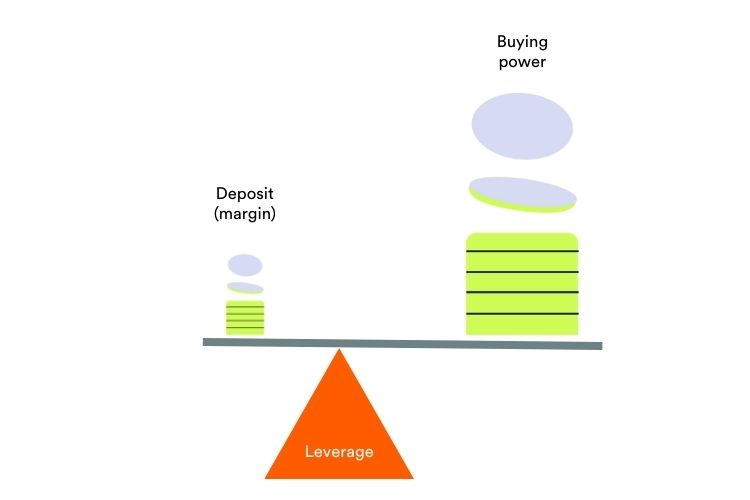
In forex trading, leverage allows you to control a much larger position of a currency pair than your actual deposit.

A diagram showing margin and buying power on a scale with leverage as the fulcrum

It’s essentially a loan provided by your forex broker that magnifies your potential profits (and losses) based on the leverage ratio.

Here’s how leverage works:

  • Margin: When you place a trade using leverage, you only need to put up a small portion of the total trade value. This is known as the margin. The remaining amount is borrowed from the broker.
  • Leverage ratio: This ratio expresses the multiplier applied to your deposit. For example, a 100:1 leverage ratio means that for every $1 you deposit, you can control a trade value of $100 ($1 x 100).
Leverage ratio diagram desktop
Leverage ratio diagram mobile

For example:

Imagine you have a $1,000 deposit and you want to buy the EUR/USD currency pair. You decide to trade with a leverage of 50:1. This means:

Margin required: $1,000 (deposit) / 50 (leverage) = $20

Trade size: $20 (margin) x 50 (leverage) = $1,000

Therefore, with just a $20 deposit, you’re essentially controlling a $1,000 position in the EUR/USD pair.

Leverage can be a valuable tool, but it comes with significant risks, because it magnifies not only your potential profits, but your losses too.

Using stop-loss orders is crucial when trading with leverage.

These orders automatically close your position when the price reaches a predetermined level, limiting potential losses.

Forex trading strategies for beginners

There’s many different ways to trade forex. The method you choose is known as your trading strategy.

Different strategies are used depending on the timeframe you wish to trade, the time you have available, and also your trading psychology. 

Here’s some of the most common forex trading strategies for beginners who are just starting to trade:

  • Day trading: Forex day traders enter and exit trades on a daily basis, hoping to predict hourly market price movements. They aim to avoid overnight holding costs. This approach is ideal for new traders who prefer shorter-term trading, or who are beginners with little money, as there are no overnight holding costs involved. 
  • Swing trading: Swing traders hold positions for several days, aiming to buy at ‘swing lows’ and sell at ‘swing highs,’ or vice versa for short positions. This method requires less time for market trend analysis compared to others, but incurs overnight holding costs and may be subject to gapping. This means there’s a significant difference between the closing price and the opening price at the next trading session.
  • Position trading: Position traders hold positions over longer periods of time, disregarding short-term price fluctuations. This strategy suits traders who take a longer-term view and concentrate on market fundamentals rather than technical analysis.
  • Scalping: This strategy involves making multiple short-term trades to capitalise on small price movements. Although I mention it here, it’s not a strategy suitable for beginners.  It’s more for traders who can dedicate a significant amount of time to trading, and focus heavily on technical analysis and very quick trading with little room for hesistation for error. 

Technical analysis for beginners

Technical analysis is a method used by forex traders to evaluate and forecast future price movements.

It is based on the belief that past price movements and trading patterns can provide valuable insights into future price direction.

Smart forex traders use these recognisable patterns to determine whether they will take long or short positions.

  • a long position is when you buy an asset and hope to sell it later for a higher price.
  • a short position is when you sell an asset and hope to buy it back later for a lower price. It is the direct opposite of trading long.

What does technical analysis involve?

Technical analysis involves learning to ‘read’ trading charts.

This means learning to recognise certain chart patterns that repeat themselves over and over again, no matter what asset you are trading.

Technical analysis also involves using indicators to show different aspects of price movement more clearly.

Elements of technical analysis include:

  • Price patterns: these include looking at price trends, support and resistance levels, and candlestick patterns to predict the next move in price action
  • Indicators: These are mathematical formulas that are displayed as lines or patterns on a basic price chart. These indicators give you more detail about aspects of price movement. They include aspects like averages, volatility and momentum
  • Market psychology: Technical analysis also involves looking at candlestick patterns to ascertain current market psychology, for example, whether prices are trending up or down

What are price trends?

A price trend refers to the general direction in which the price of an asset moves.

Price action can only move one of three ways: up, down, or sideways.

  • Uptrend: An uptrend occurs when the price of an asset is consistently making higher highs and higher lows. In other words, the overall movement of the price is upward or bullish. Forex traders look for opportunities to buy during uptrends, expecting the price to continue rising so they can sell at a higher price, and so make a profit on their trade
  • Downtrend: A downtrend occurs when the price of an asset is consistently making lower highs and lower lows over time. In this scenario, the overall movement of the price is downward or bearish. Traders look for opportunities to sell short during downtrends, anticipating further price reductions. Short selling involves making a profit when the price of an asset declines
  • Sideways or range-bound trends: A sideways or range-bound trend occurs when the price of an asset moves within a relatively narrow price range. This is known as a period of consolidation. The overall movement of the price is horizontal, and there is no clear direction up or down. Forex traders often choose to stay on the sidelines during periods of consolidation, waiting for prices to start moving again, which is known as a breakout from a sideways trend
Trading candlestick chart showing different types of price action

What are the costs associated with forex trading?

Each time you make a forex trade, you will encounter various costs. These are ‘the price of doing business.’

Forex trading costs include:

  • Spread: The spread is the difference between the bid price (the price at which you can sell a currency pair) and the ask price (the price at which you can buy a currency pair). It represents the broker’s fee for executing your trades, and is measured in pips
  • Commission: Some brokers charge a commission fee for each trade, in addition to the spread. This commission can be a fixed amount per trade, or a percentage of the trade size
  • Swap or rollover fees: Swap or rollover fees are charged when you hold a position overnight. These fees are based on the interest rate differential between the two currencies in the pair you are trading, and can either be positive or negative, depending on the direction of your trade and the prevailing interest rates
  • Currency conversion costs: If you are trading forex pairs that are not denominated in your account’s base currency, you may incur currency conversion costs when depositing or withdrawing funds from your trading account.
  • Platform fees: Some brokers may charge fees for using their trading platforms or accessing certain features or tools
  • Inactivity fees: Inactivity fees are charged by some brokers if you do not place any trades within a specified period

Understanding these costs is essential for forex traders to accurately assess the profitability of their trades, and select the most cost-effective trading strategies and brokers.

What is Subscription-Based Trading (SBT)?

Rather than charging spread, markup and conversion fees, here at MarketMates we offer a different model we’ve called subscription-based trading.

This means for a small monthly fee, you have unlimited trading per month, with no additional charges per trade.

We also have a free plan so you can trade with spreads from 0.0 and no markups at all up to $1 million a month for free! 

Final thoughts for about this trading course for beginners

Forex trading is like a busy shopping centre, where individuals, companies, and big institutions trade currencies.

It’s the biggest marketplace in the world, with trillions of dollars of money changing hands every day.

To become a successful trader, you need to understand how the forex market works. 

There are many different trading strategies for beginners, ranging from day trading to trend and breakout trading.

The style of trading you undertake will depend largely on your personality, the time you have available, and what suits your lifestyle the best.

At the heart of forex trading is currency pairs, like the British Pound/Japanese Yen. Knowing how these pairs interact is one of the keys to success. 

Till next time, good luck and happy trading!

Cate Signature

If you like this article then sign-up for our newsletter or join over 42,000 traders and get The Advanced Forex Course for Smart Traders 2.0. It’s 100% free.

Here’s an explanation of some common FX trading words:

ASX – the Australian Securities Exchange, Australia’s stock market

BC – base currency, the first currency in a pair

Brokerage fee – a fee you pay to a stock broker or brokerage site each time you use their platform to buy or sell an asset

Bear market – describes a market environment in which the majority of prices are falling

Bull market – an optimistic market in which most prices are rising

Cable – a slang market term for one of the most popular currency pairs – GBP/USD

Carry trade: A strategy where a trader borrows in a currency with a low interest rate and invests in a currency with a higher interest rate to profit from the interest rate difference

CC – counter currency, the second currency in a pair

CFD – a ‘Contract for Difference,’ which is a type of  derivative financial product that is traded based on the value of an underlying asset such as a currency pair or company share or cyptocurrency

Correlation: The statistical relationship between two assets, for example two currency pairs, indicating how they move in relation to each other – either positively, negatively, or not at all

Cryptocurrency – a form of virtual currency which only exists in the cyber world. Cryptocurrencies can also be traded online through CFDs in a similar way to standard FX trading

CPI – Consumer Price Index, which reflects the inflation rate of a particular country, and is a very important market indicator in FX trading

Day trading – a trading strategy that involves buying and selling shares in one day, and closing all positions before the end of the trading day

Derivative – a financial product that is based on the underlying value of another asset. CFDs, options and futures are all examples of derivatives

Forex brokerage: A company or platform that provides access to the forex market, facilitating the buying and selling of currencies for traders

Forex or FX trading – foreign exchange trading, converting one currency to another in order to profit from price changes

Futures contract – a contract to buy or sell an asset at a specified future date for a specified price

Greenback – a FX slang term for the American dollar, based on the colour of American $1 notes

Hedge – an investment strategy designed to offset or reduce your exposure to risk. It is related to the phrase ‘hedging your bets’

Leverage – using ‘borrowed’ money to invest so you can trade a larger position with less initial outlay. Most FX brokers offer leverage starting from 5% up to 60% or more

Loonie – the slang FX market term for the Canadian dollar (because Canadian dollar coins formerly pictured a loon on them)

Margin: The amount of money required to open and maintain a leveraged position, often expressed as a percentage of the total trade size

OTC – ‘over the counter’ – which describes the global forex market method of operation, where there is no centralised exchange, but rather trades take place directly between two parties through an electronic network connecting traders all over the world

Share trading – buying and selling shares in public companies through a stock exchange

Short trading: Selling an asset with the intention of buying it back later at a lower price to profit from a reduction in the price

S/R – support/resistance. This describes specific price levels using technical analysis on a trading chart. Support is a level below the current price which has previously acted as a floor or lowest selling point. Resistance is a price level above which the price has previously shown reluctance to climb 

Slippage – The difference between the expected price of a trade and the actual price at which it is executed,with the difference often due to market volatility or delays

SL Order – Stop loss order – a type of trading order which automatically kicks in at a certain price and closes a trade to prevent catastrophic loss

Sterling – another name for the British pound

Swap fees: Costs incurred when holding a position overnight, related to the interest rate difference between two currencies in a forex pair

Take a Position – this describes the action of opening a trade – you are said to ‘take a position’ when you choose to open a trade

TP Order – Take profit order – a price order which is set which automatically closes a position to take the profit made on that trade

Volatility – a measure of how much the value of a particular asset fluctuates on a regular basis

Marketmates uses only high-quality sources, including peer-reviewed studies, to support the facts within our articles. Read our editorial guidelines to learn more about how we fact-check and keep our content accurate, reliable, and trustworthy.

  1. Dr Van K. Tharp – Super Trader: Make consistent profits in good and bad markets. https://www.amazon.com.au/Super-Trader-Expanded-Van-Tharp
  2. Sam Eder – The Consistent Trader. https://www.amazon.com.au/Consistent-Trader-Winning-Trading-Psychology/
  3. Investopedia – Commodities Trading: An Overview. https://www.investopedia.com/investing/commodities-trading-overview/

Secure Broker-backed Funding for Traders.

Try simple, flexible ‘balance-based’ challenges. 

Picture of MarketMates Editorial Team

MarketMates Editorial Team

The MarketMates editorial team is led by ceo and co-founder Sam Eder, and consists of internal and external trading experts.
Picture of MarketMates Editorial Team

MarketMates Editorial Team

The MarketMates editorial team is led by ceo and co-founder Sam Eder, and consists of internal and external trading experts.

5 ChatGPT Prompts to Help You Pass Any Prop Firm Challenge

Build a rules-based plan in minutes using AI.

The Advanced Forex Course

for Smart Traders 2.0

Join over 42,000 traders and get FREE access to 17+ lessons and five hours of on-demand video based on the famous ‘Market Wizards’.

Keep Learning

Bank Desk Weekly
Sam Eder

Bank Desk FX Weekly 24 August 26

The US dollar remains under pressure, but this week could decide whether the weakness has further to run. PCE inflation and Fed Chair Kevin Warsh at Jackson Hole are the

Bank Desk Weekly
Sam Eder

Bank Desk FX Weekly 17 August 26

The US dollar starts the week under pressure as weaker jobs, inflation and retail data reduce expectations for another Fed rate increase.

Bank Desk Weekly
Sam Eder

Bank Desk FX Weekly 10 August 26

Weak US jobs have pushed the dollar lower and reduced expectations for further Fed rate hikes. Banks remain divided on what comes next, with US CPI, the RBA decision and

marketmates

Join over 42,000 Traders. 100% FREE.

The Advanced Forex Course
for Smart Traders