Forex trading can be an exciting adventure, but it’s also fraught with potential pitfalls, especially for those just starting out.
Understanding the common forex trading mistakes that novice traders make can help you avoid repeating the same errors, and so make your trading journey smoother.
By learning about these common mistakes and how to avoid them, you can quickly improve your trading knowledge and skills, and therefore increase your chances of success.
Between Sam and I, we have more than 30 years of trading experience.
We’ve put our heads together to bring you this vital list of the Top 20 common trading mistakes that forex traders make.
Here we provide practical tips on how to steer clear of them.
Common Forex Trading Mistakes to Avoid
Trying to decide which rookie errors to highlight in this list was a challenge, because unfortunately there are many pitfalls to trip up new traders.
However, here’s our final list of the Top 20 trading mistakes to avoid:
Mistake #1: Playing offence, not defence
When novice traders come to me, asking me to teach them how to trade, they often want to know ‘where should I place my first trade?’
They have the expectation that within a few minutes of talking to me, they will become ‘a real trader’ and have open positions in place.
In their enthusiasm to start trading, they tend to concentrate on trade entries, and where to start with opening their first position.
This is the most common mistake I see in novice traders who are just starting out on their trading journey.
They believe their trading journey starts with placing trades.
So then I have to bring them down to reality, and explain they won’t be placing any trades until they have written a trading plan, and done lots of homework and background learning.
I explain that successful day traders concentrate on defence before offence – in other words, get a risk management strategy in place first and foremost.
The No. 1 Rule for All Traders
The No. 1 rule for all traders must always centre around playing defence first, which involves protecting your trading capital.
The first rule of trading which stands above all others is:
‘Protect your trading capital at all costs.’
This involves:
- writing a trading plan detailing the strategy you will use to trade
- testing your strategy to ensure it gives you ‘an edge’
- sticking to your plan
If you lose your hard-earned trading capital by rushing into trades with poor risk-management, it’s game over.
This is why it’s vital not to make the first, most obvious mistake which novice traders make, which is to play offence (ie. try and score successful trades) before working out your defence (ie. protecting your trading capital.)
Mistake #2: Failing to plan (in other words, planning to fail)
The fact is, if you jump in and start trading without planning what you’re doing, you stand a very high chance of getting your trading capital wiped out.
Don’t think about starting to trade until you have a sound trading plan in place.
The best place to start for a beginner trader is to read extensively about how to write a rules-based trading plan.
Spend at least the first month of your trading career planning how you’re going to approach your trading and learn all there is to understand before placing your first trade.
This involves being crystal clear about:
- your reasons for wanting to trade
- your trading objectives and desired outcomes
- your trading strategy
- your risk profile
- how you’re going to enter, exit and manage your trades
- how you’re going to monitor and record your trades to ensure a cycle of continuous improvement
Without such detailed planning, your chances of trading success are very low.
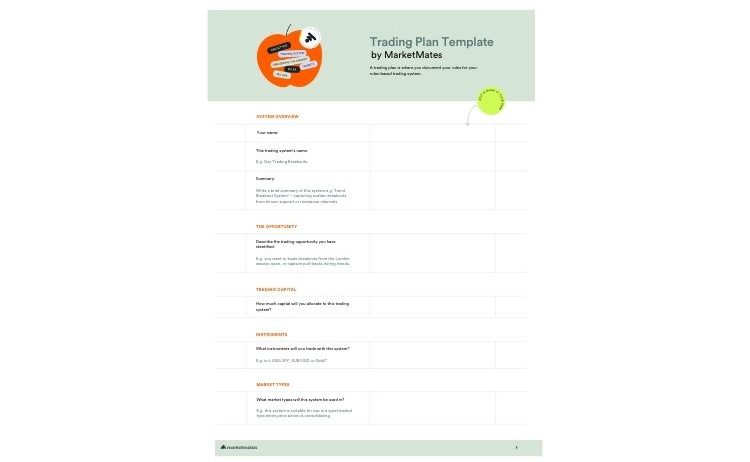
MarketMates offers a free trading plan template and lots of advice on how to complete your trading plan.
Mistake #3: Concentrating on the outcome, rather than the process
Many new traders concentrate their energy on trying to make money. This is a basic mistake.
As a new trader, your first priority should be getting your trading plan written, and understanding the process you’re going to use to trade.
Then you need to develop the discipline to stick to the trading process you’ve detailed in your plan.
Your whole focus should be first, on getting your process right, and second, sticking to the plan that will eventually lead to success.
If you concentrate on the process of trading, then the desired outcome (financial success) will take care of itself.
Mistake #4: Not using automatic stop-loss orders
Another common trading mistake that beginner traders make is not setting up an automatic stop-loss order the moment a position is taken.
Trading without having an automatic stop-loss order in place is like failing to check you’re wearing your parachute before jumping out of the plane.
Automatic stop-loss orders are absolutely vital to protect your trading capital.
You never know when a major news event or disaster is going to send the price sky-high, or drop it to depths that will wipe out your entire trading account.
Just assume this IS going to happen to you, every single day that you trade.
In my experience of training novice traders, I’ve heard all sorts of excuses for not setting an automatic stop-loss.
Common ones are:
- I don’t need an automatic stop-loss order because I’m watching the trade myself, and will get out of the trade myself if it goes negative
(Hint; no you won’t, the chances are you’ll sit there in shock and not take any action until it is too late and you’ve suffered a huge loss)
- An automatic stop-loss doesn’t take into account little whip-saws, and will close my trade unnecessarily
(Hint; better to be stopped out and lose $100, with the chance of getting back into the trade, than to sit back in shock and watch your losses mount into the thousands)
- I am better at judging where to get out of a trade than a machine
(Hint; the chances are high that a dramatic price movement could happen the moment you take a toilet break or go get yourself a coffee. An automatic stop-loss order doesn’t need coffee breaks)
Having an automatic stop-loss order in place to protect your trading capital is your safety net to get you out of trouble.
Never, ever place a trade without having your safety net in place – use an automatic stop-loss order for every trade.
Mistake #5: Failing to cut your losses short, and allow your winners to run
This is related to Mistake #4.
By not having an automatic stop-loss order in place, you run the risk of running up huge losses from which your trading account can’t recover.
Get out of any losing trade quickly according to your trading plan (don’t forget you can always get back in again if circumstances change.)
Conversely, if you’re onto a good trade, don’t cut your profits short.
My colleague Sam is fond of the phrase ‘simple entries and complex exits.’
It’s tempting to see a $500 profit on the table and close your trade to take it, whereas if you’d let it run, that $500 profit could have been turned into a $5,000 or even $50,000 one.
Divide your initial trading position up into several portions, and exit each portion separately if you’re onto a winning trade, as profit becomes available.
This is what Sam means by ‘complex exits.’
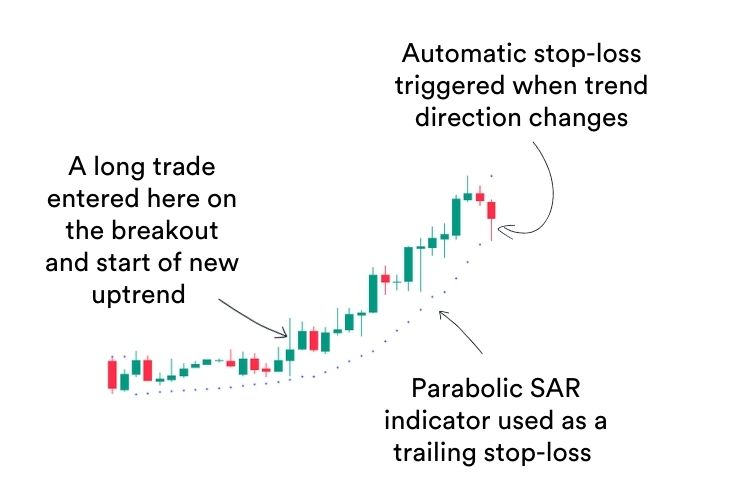
Move your automatic stop-loss to breakeven point, and then allow it to trail your profit so a portion of your profit is always protected.
This way you’ll ensure you safeguard what profit you can take, but allow your profit to run as far as it can to maximise your return.
The chart below illustrates how a trailing stop-loss based on the Parabolic SAR indicator can help you maximise your profit whilst minimising downside risk.


Mistake #6: Trading in sub-optimal conditions
Many traders don’t take their trading seriously enough, or regard it as a fun hobby.
(However, they soon discover that losing money is no fun at all.)
Many new traders attempt to trade sitting on the lounge in front of the TV, or fit trading into their work lunch-hour whilst eating at the same time.
Some try to trade while doing other jobs or minding their young children.
All these scenarios are sub-optimal if you really want to be a successful trader.
Don’t try and juggle trading with competing demands on your time and mental energy.
Don’t forget the financial market is a big scary beast that will eat you up for breakfast without a second thought.
Only ever go into battle with the financial markets when you can concentrate 100%, and are feeling at your best, both physically and mentally.
Think of mental concentration and emotional stability as the armour which will help protect you when the beast is looking for a weak trader for its next meal.
You can read all about the daily habits and tasks of world-renowned successful traders here.
Mistake #7: Not understanding the power of leverage
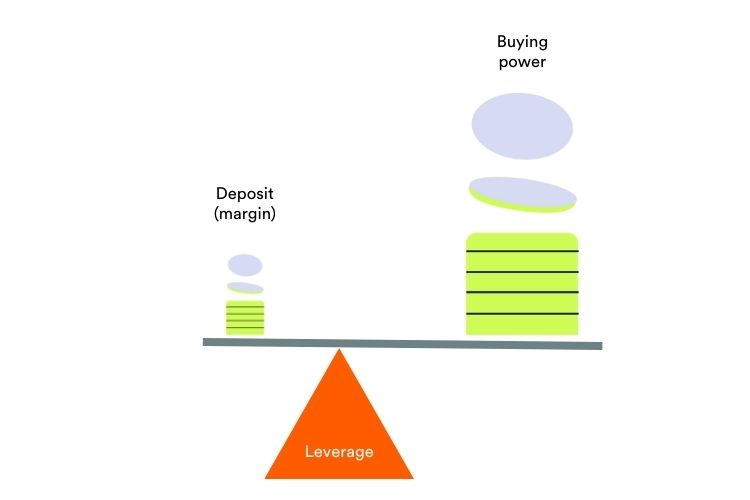
Leverage allows you to open larger positions with a smaller deposit.
While it can be a useful tool to amplify your profit potential, it is also double-edged sword, and can magnify your losses too.
Ensure you fully understand the power of leverage before using it, as it can quickly deplete your trading account if mismanaged.
As a novice trader, it’s all too easy to use all the leverage available to you.
I used to tell my new traders, just because the bank has granted you a credit card with a $10,000 limit, doesn’t mean it’s sensible to go on a massive spending spree and max out your card.
Don’t be tempted to open trades that are too large just because there’s nothing stopping you from doing so.
This is the equivalent of maxing out your credit card in one big spending-spree.
As a novice trader, use as little leverage as possible until you fully understand how it works, and have the experience to use it wisely.


Mistake #8: Not paying attention to position-sizing
Proper position-sizing is crucial to managing your risk, and risk management is the key to staying in the game long enough to come out on top.
Too large a position in relation to your overall trading account can lead to significant losses.
Too small a position might not be worth your while.
Therefore, you should always use a position-sizing technique that aligns with your risk tolerance, your trading strategy and your overall trading objectives.
If you only ever risk 1% of your trading account on a single trade, you can theoretically lose 100 times in a row before you’re wiped out.
However, if you don’t pay attention to your position size, and risk 33% of your trading account on a single trade, you could be broke after just three unsuccessful trades.
Mistake #9: Having too many positions open at one time
Managing too many open positions can be overwhelming and lead to mistakes being made.
For a novice trader, it is difficult to monitor multiple positions and to make informed decisions on multiple trades simultaneously.
A juggler who is first learning his trade starts with just one ball in the air, and then when he becomes really good at throwing that one ball up and catching it safely, he will then add a second one to the mix, and then a third as he gains experience and expertise.
When you first start trading, limit the number of positions you have open to a single trade at a time, to ensure you can safely and effectively manage and monitor your trade.
Only more experienced traders should have multiple positions open at once time.
Mistake #10: Not understanding the risk of correlation
Forex pairs are often correlated, meaning their prices move in relation to each other.
Too many forex traders (in particular) ignore these pair correlations and either take two positions at once that effectively cancel each other out, or act to multiply their risk.
This can result in trading losses on one trade being equal and opposite to any profit achieved, which results in a net zero gain.
On the other hand, having two trades with the same currency domination in common can multiply the risk and reduce the effectiveness of portfolio diversification.
It’s like putting identical weights on either side of a balancing scale. The scale remains in a neutral position and doesn’t move either up or down either way.
For example, if you have positions in EUR/USD and USD/GBP, you may effectively be doubling your risk because any gains achieved on the first trade will be offset by losses from the second, since they both involve the USD.
Share traders can also make a similar error by taking multiple positions in the same sector, or in two mining companies whose share price reacts in the identical way to a reduction in demand for the mineral they both mine.
Understanding correlation, and the relationships between different financial assets, is essential for all traders as part of their overall risk management.
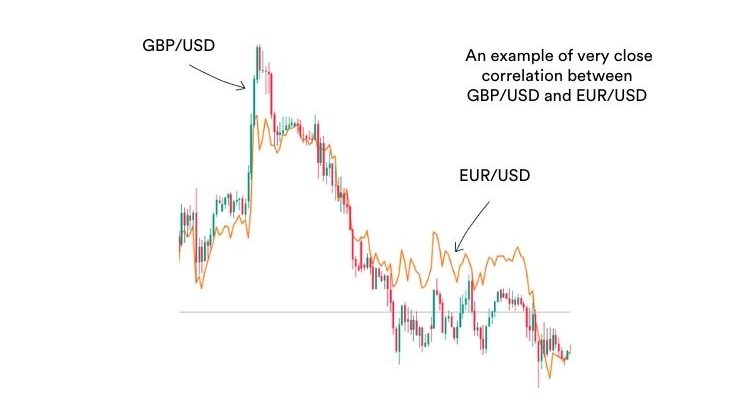
In the example below, look at the price correlation between GBP/USD and EUR/USD.


Many novice traders will make the mistake of thinking they are making two separate trades on two major pairs.
However, as these two pairs are so closely correlated, they will both react the same way to the same market news, effectively negating any diversification you may have intended.
Mistake #11: Not keeping up with market news
Market conditions can change rapidly on breaking news.
Not keeping an eye on the news, or not preparing for planned news events such as interest rate announcements can prove fatal.
No matter what you trade, breaking news events can have an immediate and drastic effect on price.
With forex this may be interest rate announcements, payroll data releases or other economic indicator news.
With shares or other company-related CFDs, this could be a company market update announcement or the release of financial data.
Interest rate announcements and inflation data can also have dramatic effects on the price of banking stocks and the price of gold.
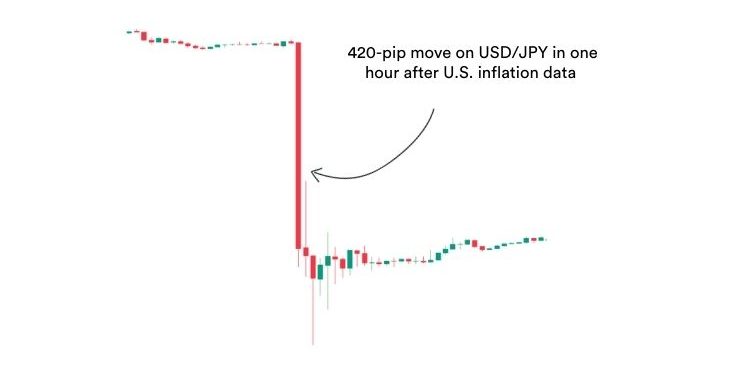
Therefore, no matter what you trade, it is important to be aware of geopolitical events and keep a close eye on news feeds as you trade.
The example below shows a 420-pip move in just one hour after a news announcement.


Mistake #12: Not understanding the mental demands of trading
Trading is a strategic mental game, as much as any game of chess or Go or Civilization is.
Many new traders underestimate how strong emotions like excitement, fear, greed and panic are the cause of many depleted trading accounts.
The emotions you may experience when trading are strong and powerful. Don’t underestimate how they may affect you, even subconsciously.
I remember early in my trading career how I felt when I had my first ‘big win’ of around $6,000.
My heart was beating so fast and hard from the adrenalin rush that I thought I was going to have a heart-attack.
Like all new traders, I had to learn to keep my emotions in check, so I could treat trading just like any other ‘job.’
I always tell new traders to respect the power of the market, and never trade when you’re feeling physically unwell, or mentally not at your best.
If you’re feeling stressed, tired, angry or sick, walk away from your trading desk and don’t return until you can offer peak performance.
The ‘market beast’ is always on the look-out for sick or weak traders when he’s hungry, so don’t make yourself an easy target for his next meal.
You can find out a lot more here about the master trader mindset.
Mistake #13: Not paying sufficient attention to technical analysis
Candlesticks don’t lie, and they are your best friend when it comes to trading.
Many novice traders make the mistake of not doing their homework, and taking the time to learn to read candlestick chart patterns.
This is an essential skill that all traders must learn, and there is no shortcut or easy way to get around it.
Trading without understanding basic chart patterns is akin to trying to read without knowing your ABCs, or trying to play violin in an orchestra without being able to read music.
When I was teaching beginner traders, I had a card pack with every candlestick shape and chart combination on different cards.
We would spend five minutes each day playing pattern recognition games until knowledge of the shape of each candlestick and pattern, and the story being told, became second nature.
Don’t start trading until you can competently understand and read candlesticks and chart patterns.
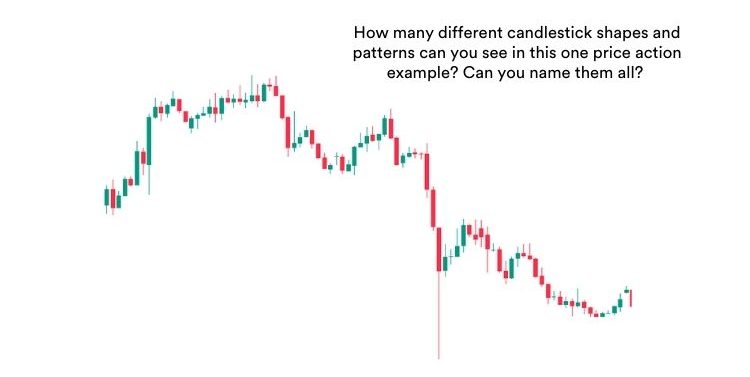
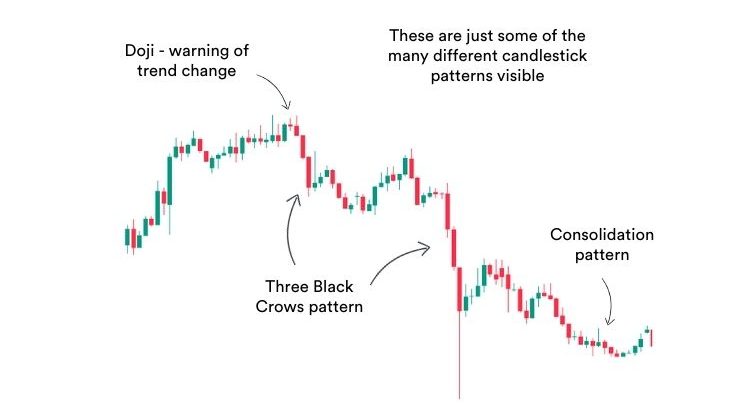
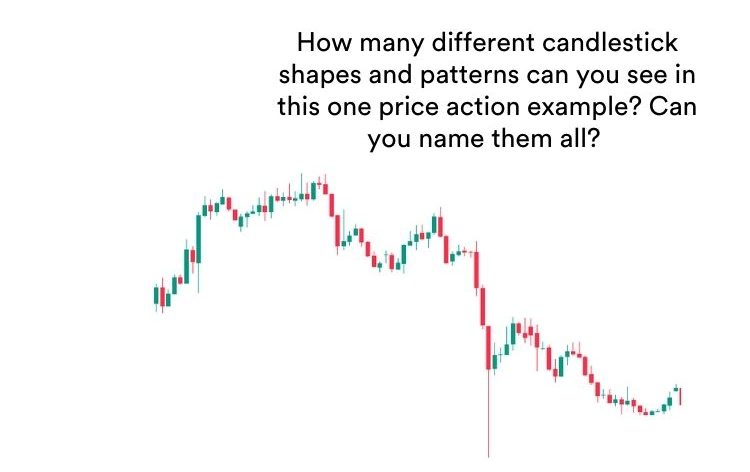
Look at the chart below, and the range of candlesticks and patterns on display in this one frame.


Can you name each candlestick and recognise each pattern?
If not, I’d encourage you to learn more.
Mistake #14: Viewing losing trades as ‘a mistake’
All traders understand ‘on paper’ that some trades will be successful, and some won’t.
Theoretically, you have a 50% chance of the coin toss turning up heads or tails.
Learning to cope with losing trades is harder than it sounds.
However, it’s vitally necessary to accept losing trades as being ‘part of the cost of doing business’ if you are to progress into trading successfully.
Many beginner traders who are not accustomed to dealing with losing trades find them hard to deal with, and so try to avoid them at all cost.
Being unable to accept trading losses can lead to a host of poor decision-making choices, which can prove fatal to your trading account.
The act of trying to avoid the emotional ‘pain’ of trading losses can lead to all sorts of disasters, including:
- removing stop-loss orders
- hiding or denying losing trades
- irrational or emotional decision-making
- dishonesty to yourself and others about your trading progress
- trying to chase or cover up losses
- mental distress leading to depression
These behaviours can all result from a fear of loss, and viewing losing trades as ‘a mistake.’
They are music to the ears of the hungry trading beast, looking for a vulnerable trader to snack on.
Therefore, accept that losses are part and parcel of trading, and stick to your trading plan.
The worst mistake a trader can make is not sticking to their trading plan.
Trading losses are not mistakes, any more than three tails in a row on a coin toss is a mistake.
Mistake #15: Trade entry typos and typing mistakes
These ARE genuine mistakes, and they can be extremely dangerous to the balance of your trading account.
Novice traders often don’t understand how important it is to check, and then double-check every trade detail that you enter, very methodically.
Don’t think that you’re a good accurate typist and won’t make mistakes. You will.
All traders make typing errors because we are human beings, not machines.
The effective successful trader spots any mistakes and corrects them before they can do any harm.
I remember back in around 2009 when I was learning to trade share CFDs. I set up a long trade on the shares of a mining company that had just released very promising results.
I was so confident this trade would be successful I decided to take quite a large position. I entered my trade and then sat back to watch my profits mount up as the price of the share shot up.
To my horror, a few seconds later, I realised that I’d entered a short trade, instead of a long position. I lost a four-figure sum in minutes. It was a painful lesson I’ve never forgotten.
As a result, I developed checklists which I had to tick off as I checked every single trade entry detail.
I’ve never made such a mistake since.

There is another common data entry issue which, in my experience, is the No. 1 reason for trading mistakes.
Coping with numerical dyslexia
Up to 20% of the population experiences some form of ‘numerical dyslexia,’ which is called dyscalculia.
This means you may type one thing, but your brain tells you that you’ve typed another numeral.
Or you ‘see what you want to see,’ not what is really there on the screen.
For example, you may intend to input 31, but type 13 instead (number reversal.)
When you look at your order entry pad, your brain tells you the number 31 is there, whereas in reality you’ve typed 13.
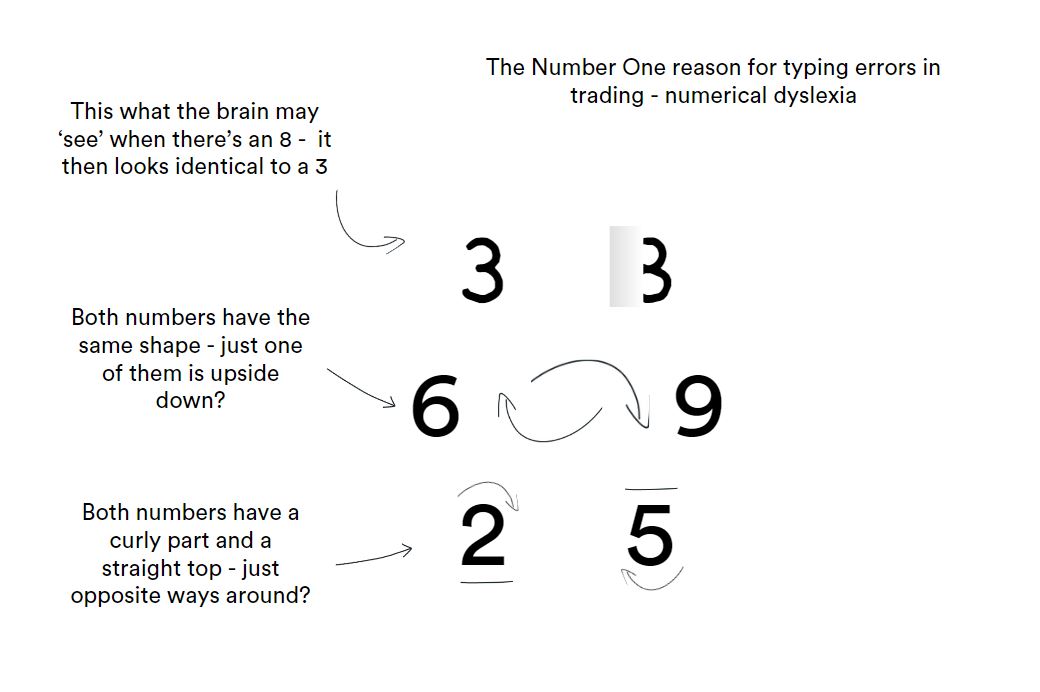
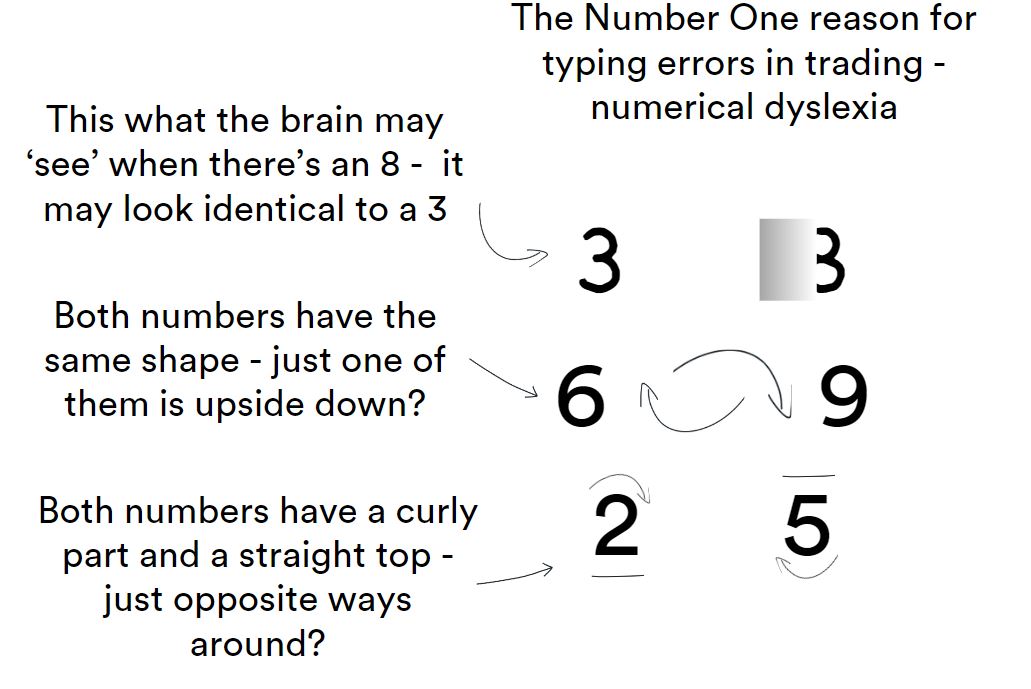
Or, you may have difficulty seeing certain numbers correctly, mixing up 3 and 8, or 6 and 9, or 5 and 2, for example.
Below is a diagram illustrating what a person living with numerical dyslexia may experience:


This is a very common trait, and is nothing to be ashamed of.
Many successful traders also experience this phenomenon (I too live with a mild form of numerical dyslexia, which only became apparent to me when I started trading.)
However, if you recognise this is an issue which affects you, it’s even more important to use checklists, and double-check every digit you enter.
As I sometimes have difficulties distinguishing sixes and nines, when I was day-trading I got into the habit of tracing the number six in the air with my finger.
If it started at the top and curled down, I knew I’d definitely typed a six! That was one of my personal work-arounds to ensure typing accuracy and avoid mistakes.
Another scientifically-proven way to overcome this issue is to proof-read your numbers backwards.
So, if you have typed a six-digit number, such as 1.35469, read it backwards to yourself out loud, saying 96453.1.
This ‘reading backwards’ trick has been proven to disrupt the habitual neural pathways of your brain, and so circumvents your brain’s tendency to mix numbers up or see them upside down or backwards.
Mistake #16: Failing to adapt your trading to the current market condition
Many beginner traders try and trade the same strategy in all market types.
This is a common mistake because a) it doesn’t work, and b) it doesn’t take into account the different behaviours of the market according to the cycle that market is in.
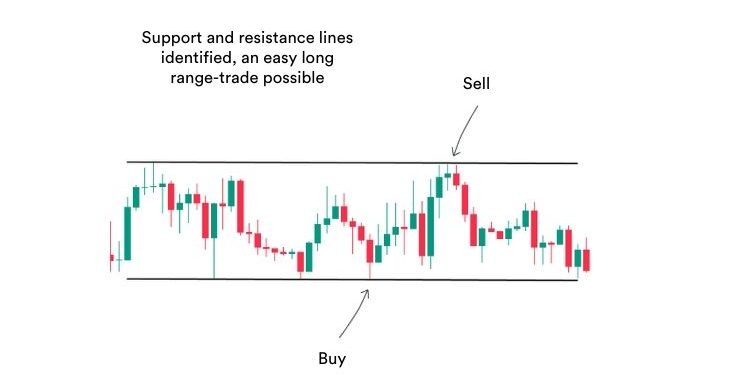
For example, say your trading strategy involves identifying support and resistance lines, and then buying when the price hits the support line in anticipation of the ‘bounce up.’
That strategy may work really well for an asset that is in a sideways normal phase. Your trade may look like this:


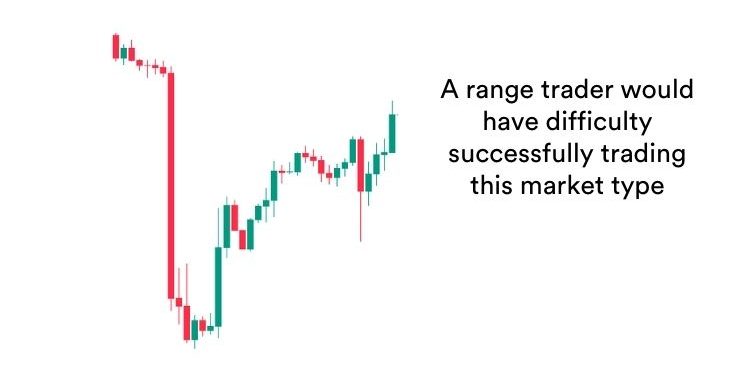
However, would you be able to successfully trade this strategy if current price action looked like this?


Different market types require different trading strategies.
Don’t try and trade the same strategy for every market type.
Mistake #17: Forcing a trade ‘just for the sake of it’ (trading too frequently)
Beginner traders also make the mistake of feeling the need to trade every time they have designated their ‘trading hours.’
I’d often hear novice traders complain ‘I can’t find a trade – can you help me find one?’
What they are trying to do is force a trade where there may not be one available that day, or that session, or even that week or month.
Don’t feel just because it’s your ‘trading time’ that you have to place a trade!
Patience is the key. There is no obligation to trade just because you feel you ‘have to be productive.’
Forcing trades is dangerous. Be patient. Wait for your ideal set-up to appear, and then trade according to your trading plan.
Remember the financial markets were there long before you were born, and they will still be there long after you’re pushing up the daisies.
There have been many times in my 16+ year trading career when I’ve stepped away from trading, and not placed a single trade for weeks, or even months.
As I grieved the death of both of my parents from cancer, I knew I was not in the right frame of mind to trade, so I stepped away until I had emotionally recovered.
Similarly, during the global financial crisis of mid-2007 I stepped away, judging the market was too dangerous for a novice trader, as I was at the time.
Don’t try and force trades. It’s a dangerous mindset that will not serve you well.
Mistake #18: Linking your trading results to your personal self-worth
This is one of the main reasons I watched novice traders give up.
They connected their trading results to their personal self-worth.
This is dangerous because it can lead to a downward spiral of depression, and can lead to a beginner trader giving up their trading dream.
Remember that the jubilant Formula One racing driver didn’t stand on that winning podium a week after he got his driving licence.
It can take years to become a successful trader and to learn the skills necessary for consistent success.
Trading is a journey of continuous improvement.
Plan your trading carefully, aim for continuous improvement, and remember that successful trading comes with time and experience.
It’s not a ‘get rich quick’ game, and a series of losing trades does not mean that you’re a failure, or a ‘bad person.’
Don’t tie your self-esteem and personal self-worth to your trading results.
This is about as logical as calling a coin a ‘bad coin’ because it produced three or four heads or tails in a row.
Mistake #19: Using too many indicators
When introducing novice traders to chart indicators, I often found they would try and cram too many indicators onto their trading charts.
Their trading chart ended up looking like the cockpit of a fighter jet, with colours and lines and buttons covering every available space.
The result of this over-use of indicators was often ‘trading decision paralysis,’ because their eyes and brains were bombarded with too much information all at once.
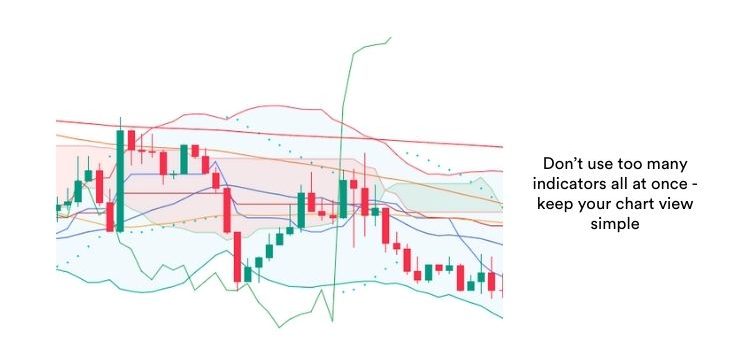
Keep your trading charts simple and only use one or two indicators at most.
Bollinger Bands and a simple market direction indictor, in addition to basic candlesticks, are sufficient to give you all the information you need to trade successfully.
Keep your focus on the main price direction and don’t get distracted by too many indicators and chart ‘clutter.’
Don’t let your trading chart start looking like this – there’s far too much information and it will do your head in!


Mistake #20: Setting yourself unrealistic goals
Many novice traders are lured into trading by social media, and headlines like ‘I made $100,000 trading in a year.’
This sort of hype is sometimes accompanied by glamorous pictures of the trader with his or her brand-new Ferrari.
The ‘from rags to riches’ story of how someone turned their life around financially in a month or two are just not realistic.
Really successful, consistent traders build up their knowledge and skills over years, not weeks or months.
There is NO Holy Grail in trading.
This article, has set out an evidence-based method to set yourself realistic trading goals and objectives.
If you follow this path, you’ll end up with a personal trading strategy that is realistic, based on science and evidence, and will work for you if you follow your trading plan calmly and consistently, and don’t give up.
It’s free, and won’t cost you a cent.
(Note: There’s no red Ferrari picture either!)
Final thoughts
I hope this list of the Top 20 common mistakes beginner traders make will help you start your trading journey in the right direction.
This list is based on years of personal trading experience, watching beginner traders make the same common mistakes over and over again.
Hopefully it will allow you to avoid making the same mistakes, and to learn from those beginners who have trodden the path before you.
I wish you well in your trading journey.
Till next time,
If you like this article then sign-up for our newsletter or join over 42,000 traders and get The Advanced Forex Course for Smart Traders 2.0. It’s 100% free.