Let’s start with a definition of what is scalping in trading.
Scalping is a high-intensity trading strategy that involves making numerous large trades in a single day to capture small price movements.
Traders who use this approach, known as scalpers, aim to open and close multiple big positions over a short time frame, often seconds to minutes, to make quick gains.
While these individual gains may be small, the frequency of trades adds up, and can potentially generate significant returns if done properly.
Scalping is most common in forex, stocks, crypto and futures markets, where quick price fluctuations provide ample opportunities for scalpers.
In this article we take a close look at what is scalping in trading, and analyse its benefits and risks.
What is the best definition of scalping?
Scalping can be defined as a trading strategy focused on profiting from small price movements by executing a high volume of large trades within a brief time period.
In this strategy, the trader’s goal is to ‘scalp’ tiny gains repeatedly, hopefully producing a larger cumulative benefit.
Each trade’s holding time is very brief to reduce exposure to market risk.
The high frequency of trades aims to leverage benefit from small, favourable price changes.
Understanding scalping and its characteristics
Scalping has distinct characteristics that set it apart from other trading approaches, such as day trading or swing trading.
Here are some of its key characteristics:
- Short holding period: Scalpers rarely hold trades for more than a few minutes and often close positions within seconds
- High trade frequency: A scalper may execute dozens, or even hundreds of trades in a single session, aiming for numerous small gains
- Leverage: Many scalpers use leverage to increase the potential gain on each trade, as they’re only looking to capture small price changes
- A focus on liquidity: Scalping requires assets with high liquidity and tight spreads, as these markets allow traders to enter and exit their trades quickly with minimal slippage
- Strict risk management: Scalpers use tight stop losses and sometimes trailing stops to minimise their risk exposure, given that small price moves can quickly go against them if they are taking large positions on each trade
Popular scalping indicators and settings to use
Scalpers rely on indicators to identify rapid price movements and execute trades within seconds or minutes.
However, standard indicator settings are often too slow to catch quick market changes.
Below are some of the most popular scalping indicators, with adjustments to make them more responsive for short-term trades.
Moving Averages (MAs)
Moving averages smooth out price data, helping traders identify trends.
In scalping, traders use short-term Exponential Moving Averages (EMAs), as they respond quickly to recent price changes, making them ideal for catching rapid shifts in price.
- Short-term EMA (5 or 8 period): This line moves quickly, closely following the latest price movements. A short-term EMA helps scalpers enter trades as soon as a trend develops
- Long-term EMA (13 or 21 period): A longer EMA provides a slower, more stable view of the trend, helping scalpers confirm that a trend is genuine.
Scalping strategy with EMAs:
Look for a ‘crossover’ between the short-term and long-term EMAs.
- A buy signal occurs when the short-term EMA crosses above the long-term EMA
- A sell signal appears when it crosses below.
The crossover technique helps capitalise on quick trend changes, and these short period settings make the EMAs highly sensitive to immediate price action.


Parabolic Stop and Reverse (SAR)
The Parabolic SAR is a trend-following indicator that marks potential reversal points.
It appears as dots on your chart, shifting from above, to below the price action candlesticks when a trend is about to reverse.
Scalpers use this indicator to tell them if price action has changed direction, as it allows them to quickly exit positions if the market moves against them.
Settings:
- The default Acceleration Factor (AF) is set to 0.02, with a maximum AF of 0.2. This setting is suitable for scalping. This is the number which appears in the ‘Start’ box in TradingView. It’s recommended to leave the Start and Increment as 0.2, with a maximum value of 0.2.
- However, you can change the timeframe of the Parabolic SAR in the Timeframe settings box. If faster responses are required, the timeframe can be reduced (for example, to five minutes) to make the dots more sensitive to price movement.
- The SAR calculation timeframe you choose does not have to be the same as the chart timeframe you are viewing. Eg, you can set the SAR indicator to five minutes, but view price action on your chart at one-minute intervals.
Scalping strategy using Parabolic SAR:
Scalpers use the SAR to place stop-loss orders at reversal points, helping protect capital if the trend changes direction.
If dots appear above the price, it signals a potential sell, while dots below the price signal a buy.
These dots can be used to identify where to place your stop-loss order to prevent losses.


Relative Strength Index (RSI)
The RSI measures the speed and change of price movements to identify overbought or oversold conditions.
Standard settings use a 14-period RSI, but scalpers often prefer shorter periods (eg. 5 or 7) to increase the indicator’s responsiveness.
Settings:
- Setting the RSI to a period of 5 or 7 increases its sensitivity, providing faster signals.
- With this adjustment, you can react more quickly to price fluctuations.
A scalping strategy using the RSI:
Watch for RSI readings above 70 to signal overbought conditions (possible sell opportunities) and below 30 for oversold conditions (possible buy opportunities).
The shortened period gives more frequent signals, though it’s important to filter for false positives in volatile markets.
The shorter the RSI settings are, the more sensitive they are, but the higher number of false signals that may be generated.
Adding a moving average to the RSI line (such as a nine-period moving average) can smooth RSI movement.
Signals where the RSI crosses above or below this moving average can indicate a potentially more stable signal.


Supertrend Indicator
The Supertrend indicator is a trend-following indicator that uses the Average True Range (ATR) to determine entry and exit points.
It plots a line on the chart, showing the overall trend direction. Scalpers find this useful as it gives a clear view of market bias.
Settings:
- For scalping, set the ATR period to eight or less and the multiplier to either 1.5 or 2
- The shorter ATR period increases responsiveness, while the multiplier keeps signals clear and helps avoid over-trading in choppy conditions
Scalping strategy with Supertrend:
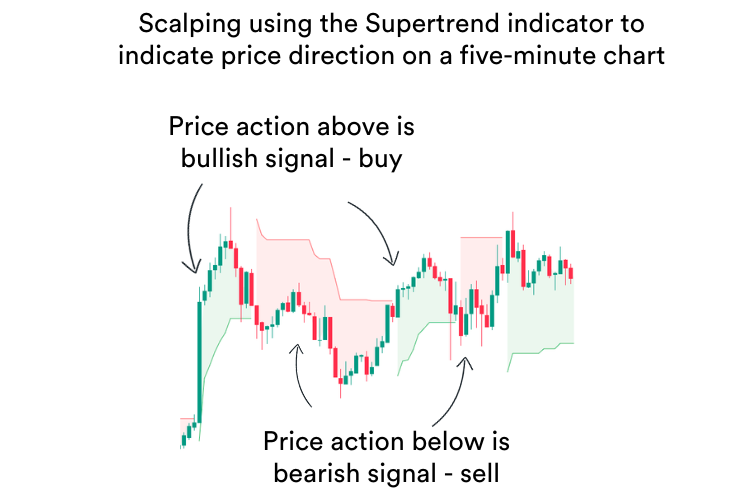
When the price is above the Supertrend line, the indicator signals a bullish trend, so look for buy opportunities.
Conversely, when the price is below the Supertrend line, it suggests a bearish trend, prompting sell opportunities.
This indicator is helpful in trending markets, but it can produce false signals in sideways markets.
Therefore, it’s best to filter for false signals in sideways markets by using the Supertrend indicator in conjunction with another indicator, such as a moving average or the RSI.
In our example below, a short buy trade at the second direction change (the second red section on this chart) would have been unsuccessful as price action ranged sideways before increasing.
This illustrates a false sell signal.


Bollinger Bands
Bollinger Bands usually consist of a 20-period moving average with upper and lower bands set at two standard deviations.
The bands expand and contract based on market volatility, creating a visual representation of potential support and resistance levels, and overbought and oversold conditions.
Settings:
- Although the standard setting of a 20-period moving average with two standard deviations is the default, scalpers may choose to reduce the MA period to five or 10 for quicker signals.
- The standard deviation at two usually works well to avoid excessive noise, but for short-term scalping you may choose to reduce the deviation to 0.5 or 1.
Scalping strategy with Bollinger Bands:
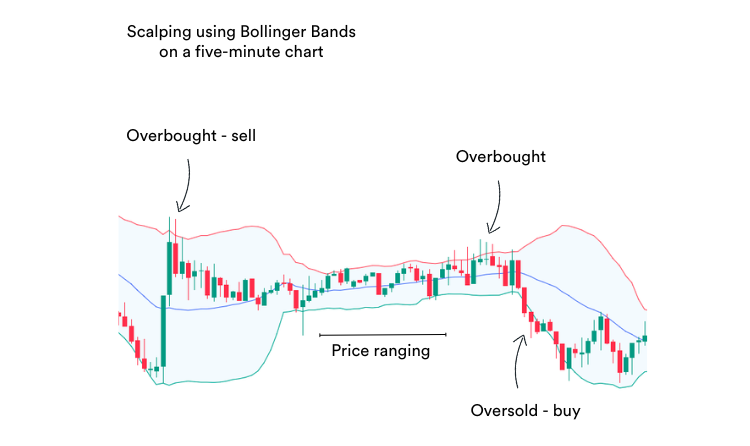
In range-bound markets, use Bollinger Bands to spot ‘mean reversion’ opportunities.
When the price touches or slightly exceeds the lower band, it’s seen as a buy signal; when it touches the upper band, it’s considered a sell signal.
This is particularly useful for capturing small profits within a predictable range, which is a common objective in scalping.
Using these indicators with optimised settings for scalping will allow you to react swiftly to minor price changes, and help find potentially profitable trade entries and exits.
Just remember that adjusting the standard settings increases the indicators’ sensitivity to short-term movements, but you should be mindful of false signals, which are more common in lower time frames.


Popular scalping strategies
Scalping strategies vary just like day trading or trend trading strategies do too.
However, they all revolve around detailed technical analysis, and rely on tools like indicators, moving averages, trend lines or support and resistance levels to make entry and exit decisions.
Here are some popular scalping techniques:
- Momentum trading: Momentum scalpers look for assets with strong upward or downward momentum, capitalising on rapid price changes driven by news, financial announcements, unexpected events or high trading volume.
- Range trading: In this method, scalpers identify an asset trading within a set price range. They buy near the support level and sell near the resistance level, capturing small moves as the price fluctuates within this tight range.
- Breakout scalping: This strategy involves catching quick price movements when an asset breaks out of a specific level of support or resistance. Scalpers enter trades as soon as the breakout is confirmed, attempting to capitalise on the initial surge.
Scalping the stock market
In the stock market, scalpers focus on stocks with high liquidity, such as large-cap stocks with substantial daily trading volume.
These stocks offer tighter spreads and quick entry/exit opportunities, ideal for capturing small price changes.
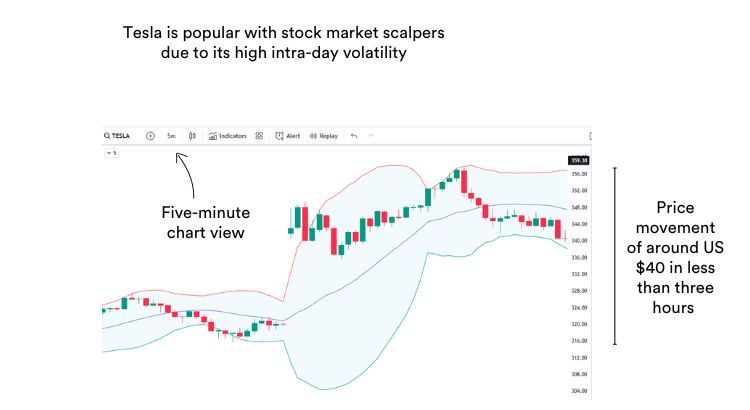
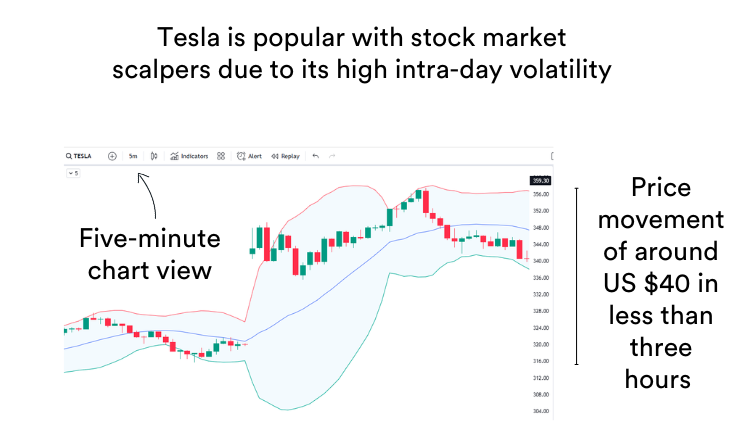
Stocks such as Tesla (TSLA) are popular targets for scalpers.
Tesla is known for its high (sometimes extreme) intra-day volatility. This volatility can be caused by a number of factors including:
- CEO Elon Musk’s social media posts on X, plus other media statements and actions
- Production and delivery updates
- Quarterly earnings reports
All of these factors and more account for Tesla being a prime target for scalpers looking to trade a stock with high volatility and deep market depth and volume.


Scalping the forex market
The forex market is well-suited to scalping, particularly major pairs like EUR/USD, USD/JPY and GBP/USD, due to high liquidity and low spreads.
Forex scalpers often use high leverage, increasing the risk but enabling greater gains on minor price movements.
Here’s some advice if you are thinking of scalping major forex pairs:
1. EUR/USD (Euro/US Dollar)
- Why it’s popular: The EUR/USD is the most traded currency pair in the world, making it highly liquid and generally associated with low spreads. Its liquidity makes it suitable for high-frequency trading and fast execution, both essential for scalpers.
- Typical trading hours: This pair tends to be most volatile and active during the overlapping European and U.S. trading session times.
2. USD/JPY (US Dollar/Japanese Yen)
- Why it’s popular: The USD/JPY is known for its predictable price patterns. The Japanese Yen is highly influenced by macroeconomic factors and news releases. The pair’s relatively high trading volume and liquidity help keep spreads tight, which is needed if you intend scalping this pair.
- Typical trading hours: It’s active during both the Tokyo and U.S. sessions, making it suitable for scalping in the late Asia and early U.S. session overlap hours.
3. GBP/USD (British Pound/US Dollar)
- Why it’s popular: The GBP/USD pair is known for its relatively high volatility compared to other major pairs, providing frequent opportunities for scalpers to capture small moves. However, it’s crucial for scalpers to manage risk carefully due to its potential for larger price swings.
- Typical trading hours: Most active during the European and U.S. trading hours, particularly the London session.

Scalping the cryptocurrency market
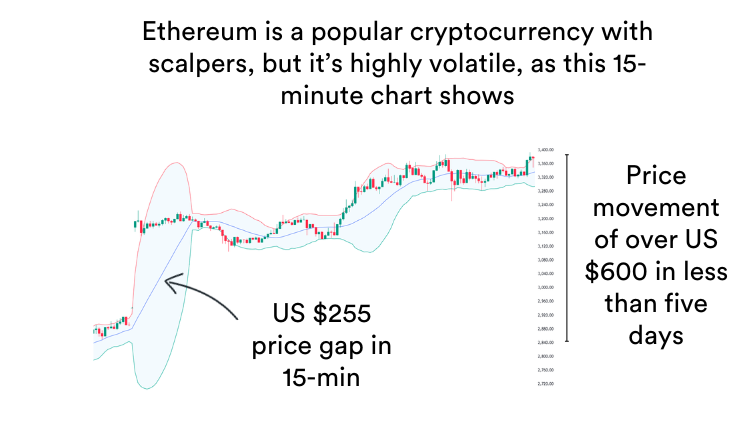
Scalping is growing in popular in cryptocurrency markets, particularly for assets like Bitcoin and Ethereum that have high trading volumes.
However, crypto markets can be notoriously volatile, increasing both the potential returns and the risks, which can be substantial.
Scalping highly volatile crypto markets is best left for highly-experienced traders with very strong risk strategies in place.
It is not recommended for beginners or less experienced traders.


What’s the difference between scalping and day trading?
While both scalping and day trading involve closing trades within a single day, scalping focuses on ultra-short trades lasting seconds to minutes.
Day traders may hold positions for hours on end, looking for larger price moves, but still all within one trading session to avoid overnight holding costs.
What’s the best way for a scalper to identify scalping opportunities?
Scalpers can identify relevant trading opportunities by focusing on:
- Assets with high trading volume and liquidity
- Using technical analysis and watching closely for breakouts, trends, or indicator patterns, using well-backtested indicators with settings optimised for scalping
- Staying up-to-date with news events and financial announcements that usually drive short-term market volatility
Can you make money scalping?
Yes, it is possible to make money scalping.
However, you need to be experienced and skilled in managing rapid trades.
Successful scalping requires practice, discipline, and an in-depth knowledge of risk management.
It is like the ‘Formula One’ of car races, best undertaken by highly experienced traders who have been in the game for a long time.
It is definitely not recommended for beginner traders.
Can you make money scalping using Expert Advisors (EAs) and algo trading?
Expert Advisors (EAs) are specialised programs developed for automated trading on platforms like MetaTrader 4 (MT4) and MetaTrader 5 (MT5).
These programs allow traders to automate their strategies by setting predefined conditions under which trades are automatically executed.
EAs or algos are widely used by forex scalpers and traders in other markets such as cryptocurrency who want to leverage the speed and precision of algorithmic trading without manual intervention.
How do Expert Advisors work?
EAs operate based on pre-programmed algorithms that use technical indicators and custom rules to identify potential entry and exit points.
For example, a scalping EA might be designed to buy a forex pair when a moving average crossover signals a bullish trend, and sell when the trend reverses.
EAs are coded using the MetaQuotes Language (MQL), the programming language for MetaTrader platforms, allowing for customisation according to each trader’s specific needs.
The role of MetaTrader in EA and algo trading
MetaTrader 4 and 5 are two of the most popular trading platforms for retail forex and CFD traders, largely because of their advanced algorithmic trading capabilities and support for EAs.
Here’s how MetaTrader supports EA trading:
- EA integration: MetaTrader’s built-in ‘Navigator’ window allows users to easily upload and activate EAs within the platform. Once added, the EA can monitor the market and execute trades automatically according to the rules specified by the trader.
- Backtesting: Both MT4 and MT5 offer robust backtesting environments, where traders can test their EAs against historical data to evaluate how the algorithm might perform under real market conditions. This feature is crucial for refining strategies before risking capital in live markets.
- Optimisation tools: MetaTrader’s strategy tester also provides optimisation options that allow traders to fine-tune the parameters of their EAs for maximum performance. This involves testing different settings and conditions to find the most effective configurations for each EA.
- Flexibility and customisation: MetaTrader supports custom indicators and complex algorithms, allowing traders to create highly tailored EAs. For example, a scalping EA can be programmed to look for breakout patterns, use trailing stops, or even adjust position-sizes dynamically, based on account equity.
What are the benefits of using EAs and algo trading?
- Speed: EAs execute trades at the precise moment pre-programmed conditions are met, often within milliseconds, ensuring very quick responses to changing market conditions
- Reduced emotion: Automated trading removes the human emotional aspect of trading, which is especially valuable in scalping where fast, consistent decision-making is essential.
- 24/7 trading: EAs can trade around the clock, making it possible to take advantage of market opportunities at any time, particularly in the forex market, which operates 24-hours a day.
Risks and considerations with EAs
While EAs offer advantages, they come with potential downsides.
Poorly coded EAs may execute trades incorrectly or overtrade during volatile conditions, leading to significant losses.
Additionally, automated systems still need monitoring, as market conditions may change in ways the EA wasn’t programmed to handle.
Traders also need to regularly update and optimise their EAs, especially if they are using strategies prone to market changes.
What are the benefits and risks of scalping as a trading strategy?
The benefits of scalping as a trading strategy are:
Benefits:
- The quick turnover of trades can generate small but very frequent gains
- High volume trading is a proactive way to accumulate gains in a short space of time
- There’s far less exposure to overnight risks such as price gapping
Risks:
- Transaction costs can very quickly add up
- Scalping requires constant focus and discipline, and is a high-intensity trading method
- There’s an increased risk if a large amount of leverage is used for frequent high-volume trades
Examples of scalping
Consider a forex trader scalping the EUR/USD pair.
If the trader observes that EUR/USD is trading in a tight range between 1.0600 and 1.0602, they might place a buy order at 1.0600 and close the position as soon as it reaches 1.0602, locking in a small profit of 0.0002 pips.
They might then repeat this process multiple times, as long as the pair continues trading in the range.
Another example could involve a stock trading at $10. If a scalper notices that the stock moves up and down by $0.10 consistently, they might repeatedly buy at $10 and sell at $10.10, aiming to capture the small 10c price movement.
Is scalping risky?
Yes, scalping is considered a high-risk strategy due to the following reasons:
- High frequency of trades: Each trade carries its own risk, so executing dozens or hundreds of trades amplifies potential losses
- Market volatility: Quick, unexpected market shifts can lead to significant losses, particularly if the scalper is using leverage
- Costs of trading: Transaction fees and spreads can eat into the small gains that scalpers aim to make, making it essential to trade with a low-cost broker such as MarketMates
- Psychological pressure: Scalping requires intense focus and rapid decision-making, which can lead to burnout or mistakes if not managed carefully
To manage these risks, scalpers rely on tight stop-loss orders and predefined exit points to limit their losses.
Final thought about scalping in trading
As a CFD stock day-trader for over 10 years, I often used scalping strategies as part of my overall trading plan.
However, I did find scalping very demanding and stressful, and usually ended up with a headache at the end of the day.
It requires very high concentration, which was almost impossible for me to sustain for more than a few hours at a time.
My advice to day traders is, if you feel sufficiently experienced to try scalping, trade for a very short period at a time, maybe once a week.
As always, keep your stop-losses very tight, and don’t over-trade.
In the big picture of trading, slow, steady and consistent is a far more sustainable and realistic approach for the majority of retail traders.
It is certainly the preferred trading strategy I’d suggest to all inexperienced traders.
Don’t hop into that Formula One racing car until you’ve got thousands of kms of driving experience under your belt!
And only race for a few laps very occasionally!
Till next time, I wish you happy and above all safe trading.

If you like this article then sign-up for our newsletter or join over 42,000 traders and get The Advanced Forex Course for Smart Traders 2.0. It’s 100% free.
Sources
Marketmates uses only high-quality sources, including peer-reviewed studies, to support the facts within our articles. Read our editorial guidelines to learn more about how we fact-check and keep our content accurate, reliable, and trustworthy.
- TradingView – charting software. https://www.tradingview.com/
- MetaTrader Trading Platform – https://www.metatrader5.com/en