


The forex market operates 24-hours a day, five days a week.
However, this doesn’t mean that all hours are equally suitable for trading.
The key to successful forex trading lies in trading during periods of high market activity, where there are significant volumes of trades.
Here we will take a close look first at global forex trading hours, and then at the Singapore forex trading session, and explain the best times to trade.
Global forex trading hours
Forex trading is divided into four major sessions:

Each of these sessions corresponds to the business hours of major financial centres worldwide.
However, unlike share trading, which is strictly governed by the opening and closing times of major stock markets, forex trading does not have a regulated central market.
Therefore, there’s no ‘opening bell’ that signals the formal start of a trading session.
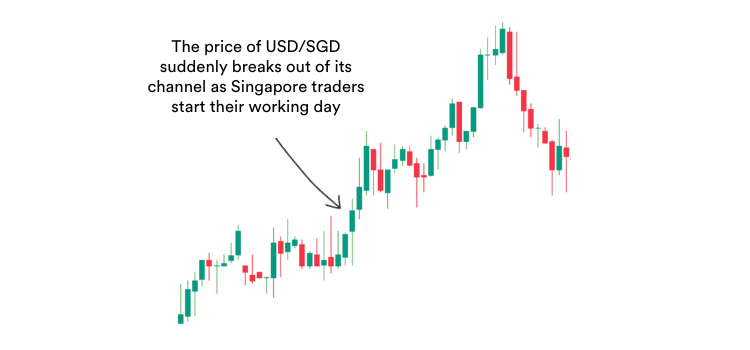
Forex session hours are more loosely based on when trading volumes start to pick up and increase, caused by high-volume professional forex brokers and traders coming online and starting their working day.
This coincides with daylight hours and the standard working day in the various time zones.
The international dateline is the official start of a new calendar day, so the trading day starts in New Zealand on Monday morning at 8.00am local time, and finishes when the New York session winds down.
It’s important to check for opening and closing session times relevant to your part of the world, which you can do below with our international market hours calculator
Market opening times often result in sharp price reversals and volatile price action, which is why it’s important to be aware of session opening and closing times as you are choosing the best time to trade.

Changes in market times also occur twice a year due to daylight savings, so you need to be aware of when clocks go back and forwards also.
The Singapore forex trading session, while not one of the four major forex sessions, plays an important role in the broader Asian trading period.
It overlaps with the Tokyo session and contributes to the liquidity and activity in the region.

Singapore session trading times
Trading hours
The Singapore forex trading hours are Monday to Friday, 5.00am to 4.00am Singapore Standard Time (SGT) the following day.
(Due to daylight saving, forex trading hours are frequently quoted in UTC or Coordinated Universal Time, which does not change with daylight savings.)
These hours coincide with the business hours in Tokyo and other parts of Asia.
Major trading session times in SGT
- Sydney session: Opens at 5.00am SGT, closes at 2.00pm SGT.
- Tokyo session: Opens at 8.00am SGT, closes at 5.00pm SGT.
- London session: Opens at 4.00pm SGT, closes at 1.00am SGT.
- New York session: Opens at 9.00pm SGT, closes at 6.00am SGT.
Characteristics of the Singapore forex session
The Singapore session has moderate liquidity, contributing to the overall activity in the Asian trading period.
While not quite as liquid as the Tokyo session, it still sees substantial trading volumes.
Market sentiment and trends
The Singapore session can influence market sentiment and trends for the broader Asian trading period.
Trends established during this session can impact the subsequent London session.
Economic data releases
Economic data from Singapore and other Southeast Asian countries can impact the Singapore session.
Key indicators such as GDP figures, inflation rates, and trade data are closely monitored by traders.
Such key events include:
Monetary Authority of Singapore (MAS) policy: Announcements and reports from MAS on Singapore’s monetary policy can directly impact the SGD.
Singapore GDP growth rate: Quarterly GDP reports provide insights into Singapore’s economic health and can also impact the SGD.
China’s economic data: Given Singapore’s close economic ties with China, data such as GDP, PMI, and trade balance figures from China can influence the SGD.
Geopolitical events
Political events and developments in Southeast Asia can significantly impact the Singapore session.
News related to regional politics, trade agreements, and geopolitical tensions can lead to increased volatility.
These can include:
US-China trade relations: Developments in the trade relationship between the US and China can create significant volatility in the forex market, affecting the SGD.
Regional Comprehensive Economic Partnership (RCEP): Changes or updates to this trade agreement, which includes Singapore, can impact regional currencies, including the SGD.
Overlap with other forex trading sessions
Below are the overlap periods between the Singapore session and the other major trading sessions.
Sydney and Singapore sessions
- Overlap period: 5.00am to 2.00pm SGT
Tokyo and Singapore sessions
- Overlap period: 8.00am to 4.00pm SGT
London and Singapore sessions
- Overlap period: 4.00pm to 1.00am SGT
New York and Singapore sessions
- Overlap period: 9.00pm to 6.00am SGT
The busiest trading times for forex in Singapore occur during the overlaps with the Tokyo and London sessions.
These periods see increased trading activity and volatility, offering more opportunities for traders.
These overlaps increase liquidity and reduce spread, providing plenty of trading opportunities especially when major economic data is released from Japan or Europe.
Trading strategies for the Asian session
During the Singapore session forex traders often employ strategies that capitalise on yen pair movements and regional economic data releases.
Scalping, day trading, and news trading are common approaches, as traders seek to benefit from the session’s moderate volatility.
Major currency pairs traded
During the Singapore session, currency pairs involving the Singapore dollar (SGD) are highly active.
Popular pairs include:
- USD/SGD
- SDG/JPY
- SDG/AUS
Movements in these pairs can be influenced by economic data releases and market events from Japan.
Below you can see how volatility increases in USD/JPY as the Tokyo session starts and Japanese traders begin their day.


Daylight savings time (DST)
The open and closing times of the various forex sessions changes in some countries twice a year due to daylight savings.
These changes occur during October/November and again during March/April.
Countries that do have daylight savings include the US, the UK, Australia and New Zealand.
It’s important for forex traders to be aware of daylight saving time changes and to adjust their trading hours accordingly.
International Market Hours Calculator
If you want to check the exact market opening hours for the region where you live, you can use this handy market hours calculator:
Frequently asked questions about forex market hours
What are the global forex market hours?
The forex market operates continuously from Sunday night at 9.00pm UTC to Friday night at 10.00pm UTC for retail traders.
What are the four forex market session hours in local time?
The four primary sessions in the forex market are:
Sydney
Open: 6.30am Monday morning (AEST)
Close: 6.30am Saturday morning (AEST)
London
Open: 9.00pm Sunday night (GMT)
Close: 9.00pm Friday night (GMT)
Tokyo
Open: 6.00am Monday morning (JST)
Close: 6.00am Saturday morning (JST)
New York
Open: 4.00pm Sunday afternoon (EST)
Close: 4.00pm Friday afternoon (EST)
What are the highest-volume session overlap times?
The highest volume session overlap times in the forex market typically occur during the following times:
- London/New York overlap: 1.00pm to 5.00pm UTC
- Tokyo/London overlap: 8.00am to 9.00am UTC
- Sydney/Tokyo overlap: 11.00pm to 6.00am UTC
These overlaps generally see increased trading activity due to the simultaneous participation of more than one major financial centre.
What are the best pairs to trade for each overlap time?
London/New York overlap (1.00pm to 5.00pm UTC):
- EUR/USD
- GBP/USD
- USD/JPY
Tokyo/London overlap (8.00am to 9.00am UTC):
- EUR/JPY
- GBP/JPY
- AUD/JPY
Sydney/Tokyo overlap (11.00pm to 6.00am UTC):
- AUD/USD
- AUD/NZD
- NZD/JPY
These pairs are popular during the overlap times due to increased liquidity and volatility, offering the best trading opportunities.
Which forex trading time sees the highest volume globally?
The London-New York overlap from 1.00pm to 5.00pm UTC typically experiences the highest trading volume in the forex market.
When is the most volatile time in forex trading?
The most volatile time in forex trading usually occurs during session overlaps, such as the London-New York overlap from 1.00pm to 5.00pm UTC. This is when the most volatility and the tighest spreads can be found.
Which forex session is best for beginners to trade?
The Sydney, Australian session is often recommended for beginners due to its relatively quiet and predictable market movements. Think of it as a shallow baby pool for traders who are just learning to swim.
How does daylight saving time affect forex trading hours?
Daylight saving time changes impact forex trading hours by shifting session times relative to UTC. In the spring clocks are put forward an hour, and in the autumn they go back an hour.
Daylight savings time changes happen in several major trading centres including New Zealand, Australia, London and Canada and the US.
Traders should stay informed about seasonal daylight saving market opening and closing times, and adjust their trading timetable accordingly.
Which countries change their time due to daylight saving time (DST?)
Australia: Observes DST in most states and territories, except Queensland, Western Australia, and the Northern Territory.
Canada: Most provinces and territories observe DST, except for a few regions like Saskatchewan and parts of British Columbia.
European Union: Most countries in the EU observe DST, although there have been discussions about potentially ending the practice.
United Kingdom: Observes DST, moving clocks forward one hour in spring and back one hour in autumn. This means during summer, GMT is the same as UTC, but in winter it is one hour behind UTC.
United States: Most states observe DST, with exceptions in Arizona (except for the Navajo Nation) and Hawaii.
New Zealand: Observes DST, typically from late September to early April.
Mexico: Most parts of Mexico observe DST, although some bordering regions with the United States may have different practices.
These changes affect local time relative to GMT in March/April and again in September/October.
Final thoughts
You can trade forex somewhere in the world 24-hours a day, 5.5 days a week.
The overlap in world time zones means that as the US markets are closing, the Australian and Asian markets are opening, followed by the European markets, continuing the trading day around the clock.
This allows forex traders to fit trading around their personal time restraints and the other work, family or study responsibilities they may have.
The best advice for novice forex traders just starting out is to pick a time of the day and week that fits in with your life, and designate this as your trading time.
Pick a major forex pair that is relevant to the trading session you are participating in, and get to know the peculiar characteristics of that one trading session intimately.
Don’t try and trade multiple pairs simultaneously across different forex sessions.
Stick to one pair, and one session, and work on developing your trading skills before branching out into another session or pair.
Day or night, forex trading is possible at almost any time that’s convenient to you, so I hope you enjoy your trading journey.
Till next time, happy trading!

If you like this article then sign-up for our newsletter or join over 42,000 traders and get The Advanced Forex Course for Smart Traders 2.0. It’s 100% free.
Sources
Marketmates uses only high-quality sources, including peer-reviewed studies, to support the facts within our articles. Read our editorial guidelines to learn more about how we fact-check and keep our content accurate, reliable, and trustworthy.
- Investopedia – The Best Times To Trade Forex. https://www.investopedia.com/articles/forex/08/forex-trading-schedule-trading-times.asp


