Fact checked

At MarketMates, we are committed to providing accurate information. Our content undergoes a rigorous process of fact-checking before it is published. Learn more about our editorial policy.
Last updated on March 18th, 2025
  Written by 
Sam Eder

Author

Sam Eder
Sam is the cofounder and CEO of MarketMates. He has worked for brokers since 2008 and is the author of the Amazon best-seller 'The Consistent Trader.' His 'Advanced Forex Course for Smart Traders' has over 45,000 students.
Our authors

Lesson #11 : Live Trading Guide: Tips for Mistake-Free Trading

How to execute your trades with patience, discipline and consistency

In this article

In this article

Now the fun begins!

After the hard work of writing and testing your rules-based plan, you are now ready to get your feet wet.

It’s time to test yourself against the market by live trading your plan.

In this lesson, I’ll give you some real-life guidance on implementing your plan so you can learn from experience and avoid some of the mistakes I’ve made.

What is a mistake?

In the context of a rules-based trading plan, a mistake is simply:

Not following your trading rules.

A losing trade is not a mistake. If you followed your rules, you did the right thing.

Remember that losing trades are a necessary part of risk management.

There are two types of mistakes you can make:

  1. Technical errors (such as typing in the wrong size order)
  2. Mental errors (such as closing a trade early because you were afraid of losing profits)

In this lesson, we will address technical errors. The final section of this course, from Lessons 14-17, covers the mental side of the game.

Live trading as an experiment

The frame of mind to have when live trading is that of a scientist.

You are simply testing your hypothesis (your trading plan) in a live environment to see how it works.

You are NOT trying to make money yet.

Rather, you are validating and testing your rules. Based on the results, you will then come up with a new hypothesis to test again.

Eventually, through this process, you will start doing more of what works and less of what doesn’t, which will ultimately end up in a profitable trading plan.  

This topic is covered in detail in the next lesson.

Should you trade using a demo account?

While I think there is a place for demo trading, I’ve not personally traded much using a demo account.

You can use a demo account if:

  1. You are not familiar with the trading platform and need to gain some experience, so you don’t accidentally press the wrong button
  2. You are limited financially, but want to practice trading

Rather than demo trading, I believe you are better off trading on a live account, even if your position size is small.

Real money keeps you accountable, and helps you develop the skillset of live trading.

You need to get comfortable with managing real profits and taking real risks.

Additionally, demo accounts don’t offer the same trading conditions as a live account.

You may not get the same spreads, and you won’t experience slippage like on a live account.

This means that a strategy that works on a demo account might not work on a live account, so your time could be wasted.

Ultimately, I’ll leave this decision up to you. But if you want to get good at trading, you need to live trade.

Plan your day carefully

Good preparation prevents poor performance. This is why it’s essential to prepare for the day or week’s action before the trading session begins.

This includes marking up your charts and making sure you are aware of any upcoming news events that could impact your trades.

Mark up your decision points

As a day trader, I mark up my charts each day with the key price levels that could force me to take action. I call these ‘decision points.’

Normally, these will be prior support or resistance levels. 

I am not interested in every level, only those that I think the price could reverse off.

Then when I am trading, I carefully watch the price action around these levels for signs of a reversal.

A reversal could then trigger exiting or entering into a position, depending on your trading plan.

The reason I like to do this in advance is because I don’t want to be making these decisions later in the day when I’m trading.

I’m more objective and less subject to bias than when I may have a live position open, or am about to enter one.

Here is an example of a trade that I exited out of based on a reversal pattern on a decision point (incidentally a long trade here would have worked well too.)

A trading chart showing where to enter and exit trades and a major decision-point

News and news events

Forex traders need to pay attention to news events, even if you are a technical trader, like I am.

In this instance, I am talking about scheduled news events. It’s also important to plan for unscheduled news, and this is part of Lesson 13, which covers contingency planning.

News events have a significant impact on price action in three main ways:

  1. Leading up to the event: Price action is often muted or rangebound, both immediately before the event that day or even that week if the event is large enough. There may be a burst of activity directly before the event as large players either take or close positions.
  2. During the event: Once the event occurs, there can be extremely rapid price movement, sometimes of several hundred pips, in one or both directions. The spread may widen and the trader may experience slippage.
  3. After the event: Volatility will often remain high with rapid moves. A suitably strong catalyst may trigger a trend or the move created by the event may quickly reverse.

This knowledge can help guide trading decisions.

To determine what events are important, you can read market news. Analysts will point out what events may be volatile or high impact.

Additionally, trading event calendars (such as can be found on TradingView) will mark events as low, medium or high-impact. Your main focus will be on high-impact events.

In general, the news events you want to watch out for include:

  • Interest Rate decisions
  • Central bank meetings, press conferences or speeches
  • Employment data
  • Retail sales
  • Inflation rates
  • Geopolitical events such as elections or important votes such as Brexit

These events wax and wane in importance based on the view of traders.

As I write this, inflation data is moving the markets, as central banks are very sensitive to inflation.

While this may sound complex, you can find out the current focus by reading analyst commentary.

After reading the news for a month or two, you will get a feel for it.

It pays to review upcoming news events at the start of the week, and each trading day.

For more information about the 12 daily tasks of successful traders, you can find out more information about this topic here. 

Entering trades without making mistakes

Once you have completed your preparation and market analysis, you can begin to stalk your entry.

At this point, you should be very clear about what will trigger your entry, but even so, it pays to follow a disciplined process to avoid making mistakes.

This includes:

  • Using a checklist
  • Double-checking orders
  • Being aware of ‘directional dyslexia’

Using a checklist

Your checklist is a summary of your entry rules from your rules-based plan. It includes each of the conditions that you require to be met before you place your entry order.

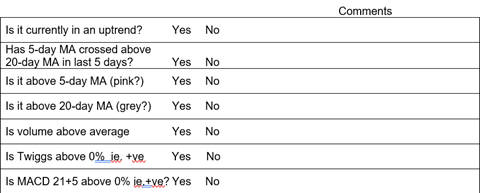
Here is an example of a checklist that Cate, our MarketMates Trading Coach, used when she was a full-time CFD trader.

An example of a trading checklist


Each line on this checklist relates to one rule in her trading plan for entering a trade.

For example, the first line ‘Is it currently in an uptrend?’ relates to her rule that long positions should only be made on a stock that is currently in an established uptrend.

The second line relates to her rule that trade entries must always be made within five days after the 5-day Moving Average line crosses above the 20-day Moving Average line.

Therefore, each checklist item reminds her to check the potential intended trade against each of her entry rules.

While Cate is a CFD stock trader, the same principles apply to forex trading.

A checklist is simply an easy-to-follow summary of the pertinent trade entry conditions that must be fulfilled prior to taking a trade, compliled from your rules-based trading plan.

Double checking orders

Once your entry conditions have been triggered, you will need to place your entry order.

If you are splitting your position into several parts with different fixed targets, this will mean that you need to enter one order per part.

There are three types of orders that you could use (based on your plan).

Stop entry and limit entry orders are used to place orders at specific prices. These are relatively simple to use as you can set them in advance.

If you are day trading, and using a market order to enter, this can be a little more complex. 

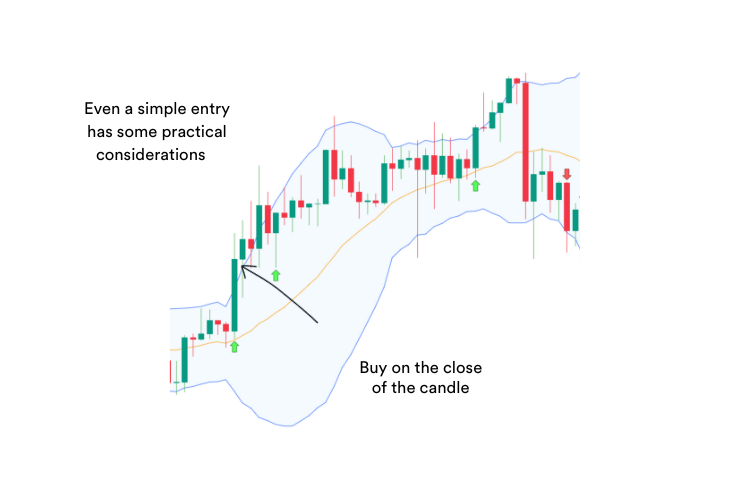
The trading strategy I used in the example at the start of this course used a market entry, based on the close of a candlestick over either the upper or lower  Bollinger Band.

Here is an example:

A trading chart showing Bollinger Bands and where to enter a trade

This seems simple right?

Well, not quite:

  1. Do you wait for the final close of the candle before entering?
  2. What if you are entering the trade in multiple parts?
  3. What if the entry signal is flicking on and off?

These are all real considerations that can impact your trading performance, in particular if you are day trading.

I settled on placing half of the position in the 10 seconds leading up to the close of the candle, and the other half immediately on the close of the candle. 

You will need to test what works for you.

Once you have placed your orders, no matter if they are market, stop or entry orders, you need to check them.

This should become an ingrained habit, and I’ve included a line for this on the checklist template (coming soon.)

Losing money is part and parcel of trading, but taking a loss or missing out on a winning trade due to incorrectly entering an order is a frustrating experience I hope you can learn to avoid!

Be aware of ‘directional dyslexia’

Another lesson that Cate and I have learnt over our combined 30+ years of trading is to be aware of directional dyslexia, also known as reversal dyslexia. 

This is the phenomenon where your brain tells you to enter a particular number or letter, but that message gets mixed up between your brain and your fingers.

It can result in entering numbers that look similar. Very commonly mixed-up numbers include 6 and 9, 3 and 8, and 2 and 5. 

Your eyes may tell you what your brain wants to see, but that may not be what is actually on the page or screen. 

(It is thought this condition may affect up to 20% of the population, although estimates range from 5% to 20%.)

Cate has some additional advice for those of you who are prone to this condition – double-check your numbers backwards ie. reading from right to left if you are a native English-speaker. 

By reading a string of numbers backwards, you will disrupt your brain’s automatic processing function and force it to see what is actually written, not what you think you’ve typed.

Also, by being aware of this phenomenon, and paying very special attention each time you type a 6, 9 or 0, you can also reduce such unconscious mistakes.

This is particularly important when trading forex, which can involve numbers to four or even six decimal places. 

Always check and then double-check your typing carefully before hitting the ‘enter’ button! 

Ensure all orders have a stop-loss order attached

The final point to make is to ensure every order has a stop-loss attached.

From my time working in brokerages, I know that over 90% of trades made by retail traders don’t have stop-losses… and over 90% of traders lose money. This is not a coincidence.

Using stop-loss orders and focusing on the risk/reward of your trades will take you a long way.

So please ensure every entry order you place has an attached stop-loss order attached to it – with no exceptions.

Trade monitoring hints and tactics

I’ve spent a lot of time in the past three years perfecting practical trade management.

Most of us have busy lives, and we need to fit our trading around our work and family.

Here are some tactics you can use to make sure you effectively monitor your positions.

Use a timer app

If you need to regularly review your charts, such as every 15-minutes or one-hour, a great way to do this is to download a timer app on your phone.

You can create a custom schedule of alarms that will alert you to check the charts. I set two alarms:

  1. Three minutes before
  2. One minute before

These alerts will keep you from missing crucial entries, exits or price patterns.  

Setting alerts

Perhaps the biggest game changer is TradingView alerts.

Not only can you put alerts on the chart at certain prices, but you can add them to indicators.

You can see here that I have alerts on the Market Type and Bollinger Band Relative Width indicators so I’ll be notified when market type changes or volatility picks up.

A trading chart showing alerts set on indicators

I suggest you make great use of this functionality, and set alerts for your rules, important prices and decision points.

Trailing stops using indicators

I like to trail my stop-loss on indicators, but I will turn them off before I enter into a trade so my charts are uncluttered.

If you are doing this, then ensure you turn your indicators and alerts back on again once you have entered a trade.

After that, you will need to make sure you adjust your stop-loss order as the trade moves in your favour.

This is important, otherwise you will give back more profit than anticipated. Use the alert system above to remind you to do this. 

Technical mistakes to avoid

There are two other technical errors worth mentioning, both of which have caused me losses in the past.

Spread widening

After the New York close there can be a period where the spread will widen on currency pairs. This widening also occurs before the close of the market for the weekend.

This is due to two things:

  1. The daily rollover process when positions that are not settled are charged a fee which can temporarily increase the spread
  2. Illiquid market conditions i.e. there are not a lot of traders around, as US traders have finished and Japanese traders are yet to arrive at their desks.

It’s important to avoid trading during these times.

I remember when I had an order triggered and closed at the same time due to this, so don’t make the same mistake as I did.

Trading long and short (hedging)

In general, I don’t advise trading long and short on the same currency pair at the same time.

Some brokers allow you to do this in what are called ‘hedging accounts.’ In these accounts, rather than close a trade, you can open another trade in the opposite direction.

Doing so is costly, as you end up paying costs on two trades rather than one.

If you are not using a hedging account you may face another issue.

Let’s assume you are long USD/JPY. If you have an order for a short position triggered, it will close out the long position. In this case, you would no longer have a short or long position open.

Speaking from experience, if this happens inadvertently, then you could miss out on a winning trade.

Over to you now

Now it’s over to you to begin live trading your rules-based plan.

The key mindset here is to treat it like an experiment. You are here to test your hypothesis in an objective way – just like a scientist.

If an individual trade loses money – while it may hurt – remember, it’s just part of the process.

Start by executing 10 live trades exactly per your plan.

You will learn a lot about your plan (and yourself) by taking this disciplined approach.

In the next lesson, we’ll cover how to monitor and improve your trading performance.

See you there.

Sam Eder signature

Marketmates uses only high-quality sources, including peer-reviewed studies, to support the facts within our articles. Read our editorial guidelines to learn more about how we fact-check and keep our content accurate, reliable, and trustworthy.

  1. Dr Van K. Tharp  – Trade Your Way to Financial Freedom  https://www.amazon.com/Trade-Your-Way-Financial-Freedom/
  2. The Prevalence of Dyslexia: A New Approach to its Estimation – National Library of Medicine https://www.ncbi.nlm.nih.gov/pmc/articles/PMC8183124/
  3. Christopher Tate – The Art of Trading https://www.tradinggame.com.au/product/trading/the-art-of-trading-2nd-edition/
Picture of Sam Eder

Sam Eder

Sam is the cofounder and CEO of MarketMates. He has worked for brokers since 2008 and is the author of the Amazon best-seller 'The Consistent Trader.' His 'Advanced Forex Course for Smart Traders' has over 45,000 students.
Picture of Sam Eder

Sam Eder

Sam is the cofounder and CEO of MarketMates. He has worked for brokers since 2008 and is the author of the Amazon best-seller 'The Consistent Trader.' His 'Advanced Forex Course for Smart Traders' has over 45,000 students.

The Advanced Forex Course

for Smart Traders 2.0

Join over 42,000 traders and get FREE access to 17 lessons and 5 hours of on-demand video based on the famous ‘Market Wizards’.

The Advanced Forex Course

for Smart Traders 2.0

Join over 42,000 traders and get FREE access to 17+ lessons and five hours of on-demand video based on the famous ‘Market Wizards’.

Keep Learning

Gold CFD Trading | MarketMates

Gold trading guide Gold CFD Trading (XAU/USD) Learn how Gold CFDs work, what moves the XAU/USD price, and how costs, margin and leverage affect every trade. Open the MarketMates portal

Bank Desk Weekly
Sam Eder

Bank Desk FX Weekly 24 August 26

The US dollar remains under pressure, but this week could decide whether the weakness has further to run. PCE inflation and Fed Chair Kevin Warsh at Jackson Hole are the

Bank Desk Weekly
Sam Eder

Bank Desk FX Weekly 17 August 26

The US dollar starts the week under pressure as weaker jobs, inflation and retail data reduce expectations for another Fed rate increase.

marketmates

Join the Course

Join over 42,000 traders and get FREE access to 17+ in-depth lessons.

Join over 42,000 Traders. 100% FREE.

The Advanced Forex Course
for Smart Traders